Four terms, different questions
Natural origin, laboratory growth, treatment and imitation describe different aspects of a material. A natural gem may still receive treatment. An appearance treatment need not turn it into another mineral, while an imitation may use a different substance to resemble the desired one.
These are not simply visual ranks. What matters is an accurate description that meets your requirements. You may enjoy a treated color while still wanting to understand exactly what is offered.
Swipe to see the full comparison
| Term | What it concerns |
|---|---|
| Natural material | Formation origin, not automatically absence of treatment |
| Laboratory-grown or synthetic | An artificially grown material requiring accurate identification |
| Treatment | A process affecting appearance or stability |
| Imitation or simulant | A similar appearance potentially made from a different material |
A material name should say more than its color
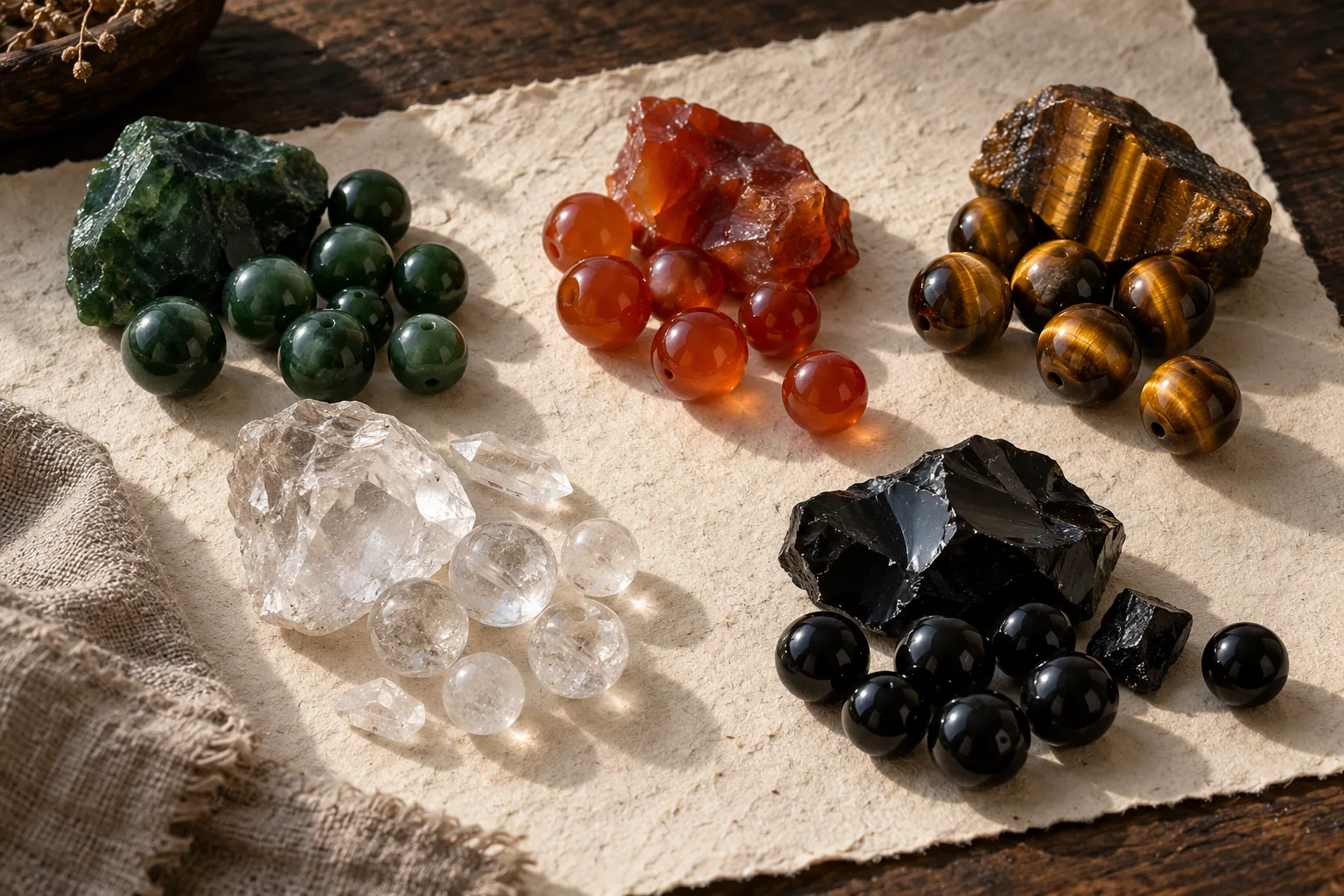
Green does not necessarily mean jadeite, blue veining does not establish turquoise, and black does not identify obsidian. Trade names can also need clarification. A precise English or mineral name may help resolve the intended material.
Howlite and turquoise are different materials. Read jade designs individually too: the approximately 6 mm nephrite bracelet is identified specifically as nephrite. Include any requirement for a particular variety, color origin or document alongside your selected design.
A mixed bracelet should describe its several ingredients. Information about the main bead does not establish every companion as the same material. Confirm where and how the stone you care about appears in the complete arrangement.
Why treatment information matters
Dyeing, heating, filling and coatings can change appearance, and some affect care needs. GIA’s treatment reference distinguishes these processes and notes that professional observation or instruments may be required to detect them.
For citrine, heat-related color is a specific material question; for jadeite, identity and treatment status both matter; blue-dyed howlite remains howlite. Different gems raise different questions, so one water test or photograph cannot identify every bead.
An untreated or particular natural-color requirement should refer to the actual proposed material. When treatment information is supplied, read what it means rather than only a quality label. Disclosure also helps you care for the finished item.
What an identification report can describe
GIA’s public description of a colored-stone identification report includes material identity, natural or laboratory-grown status and detectable treatments, together with descriptive measurements and features. Origin opinions belong to specified report services and materials rather than every report automatically.
Such a report is not a universal quality score for all colored gems, a sale-price valuation or proof of a Feng Shui effect or ceremony. Those are separate questions. Reading a document for the purpose it actually serves makes it more useful.
If you need material documentation, tell us whether the question concerns identity, treatment or origin and identify the chosen design. A report should correspond to the actual item and be read with its institution, number and scope. Gemological sources help explain that terminology.
Match the record to the item
Check the laboratory name, report number and official lookup route, then compare the photograph, dimensions, weight, shape and description. Official Report Check services confirm consistency with database records; the record must still correspond to the item you are considering.
A report for one loose stone does not automatically cover every bead in a later mixed bracelet. A whole-item document also needs its actual scope read. A number-only screenshot is less useful than complete, readable information.
For a meaningful purchase, the description, verifiable document and item presentation should support one another. Scratching glass, burning or applying harsh solvents can damage an object while still failing to answer its full identity and treatment questions.
Material facts and personal intentions
Feng Shui, prayer-bead, Pixiu and auspicious names can describe cultural themes or motifs. They do not alone establish a material or prove that a religious ceremony occurred. A specific ritual or use needs its own description and source.
A personal design may connect a BaZi energy pattern, favorable elements and a wish with the materials. The item still needs clear composition, dimensions and treatment information. Meaning and material facts can be complete together without substituting effect claims for product information.
Questions & answers
Does natural mean no dye or heat treatment?
Not necessarily. Natural formation and later treatment are separate dimensions and should be described separately.
Does a higher price guarantee a respected report?
Price does not replace documentation. Whether a report exists, who issued it and what it covers need explicit information.
Can a photographed fracture or bubble settle authenticity?
One simplified feature cannot answer every material question. Inclusions, treatment and identity need appropriate knowledge and testing where required.