
Why Five Phases is another translation
The traditional framework describes qualities and relationships rather than only five physical substances. The Great Plan chapter of the Book of Documents characterizes the elements through ways they act, reflecting a language of observation and classification.
Five Elements is the familiar English expression; Five Phases emphasizes movement and change. Both may refer to the same framework. A difference in translation does not automatically indicate an unrelated method.
Generation and control
The common generating sequence is Wood to Fire, Fire to Earth, Earth to Metal, Metal to Water and Water to Wood. The controlling sequence is Wood to Earth, Earth to Water, Water to Fire, Fire to Metal and Metal to Wood. The directions differ, and generation is not automatically always good while control is always bad.
Traditional interpretation asks whether support or restraint suits the existing arrangement. A relationship may call for nourishment or limits depending on its conditions; one arrow alone does not predict a real-world outcome.
Learn the directions before reading Day Master and Ten Gods relationships. Changing the reference point changes whether a relationship is producing me, produced by me or another category.
Swipe to see the full comparison
| Element | Generates | Controls |
|---|---|---|
| Wood | Fire | Earth |
| Fire | Earth | Metal |
| Earth | Metal | Water |
| Metal | Water | Wood |
| Water | Wood | Fire |
Amount and strength are different
A distribution chart may count visible stems and branches, include hidden stems, or weight season, position and relationships. A percentage therefore needs its calculation method explained. Two charts may be presenting different kinds of information.
A larger count is not automatically stronger under every traditional method, and a smaller count does not automatically mean more is needed. Seasonal setting, roots, support and restraint can change the interpretation of the same characters. Simple counting is a useful observation, not a complete favorable-element assessment.
Before comparing tool outputs, check that they count the same layer. A visible-character chart and a hidden-stem weighting model need not produce identical numbers, even when the underlying pillars agree.
Missing, weak and favorable
Missing may mean an element does not appear under a particular counting rule. Weak describes an interpreted condition. Favorable concerns what relationship or element is considered useful within the whole arrangement. These are different claims.
A display with no Water does not directly establish that every blue or black material suits the wearer. A personal composition needs its favorable-element basis, while a ready-to-wear protection or affinity design can be chosen for its intention.
Nor is equal division into five shares the only goal. Traditional interpretation concerns the workings of a specific structure rather than giving everyone the same percentages.
Color as a cultural expression
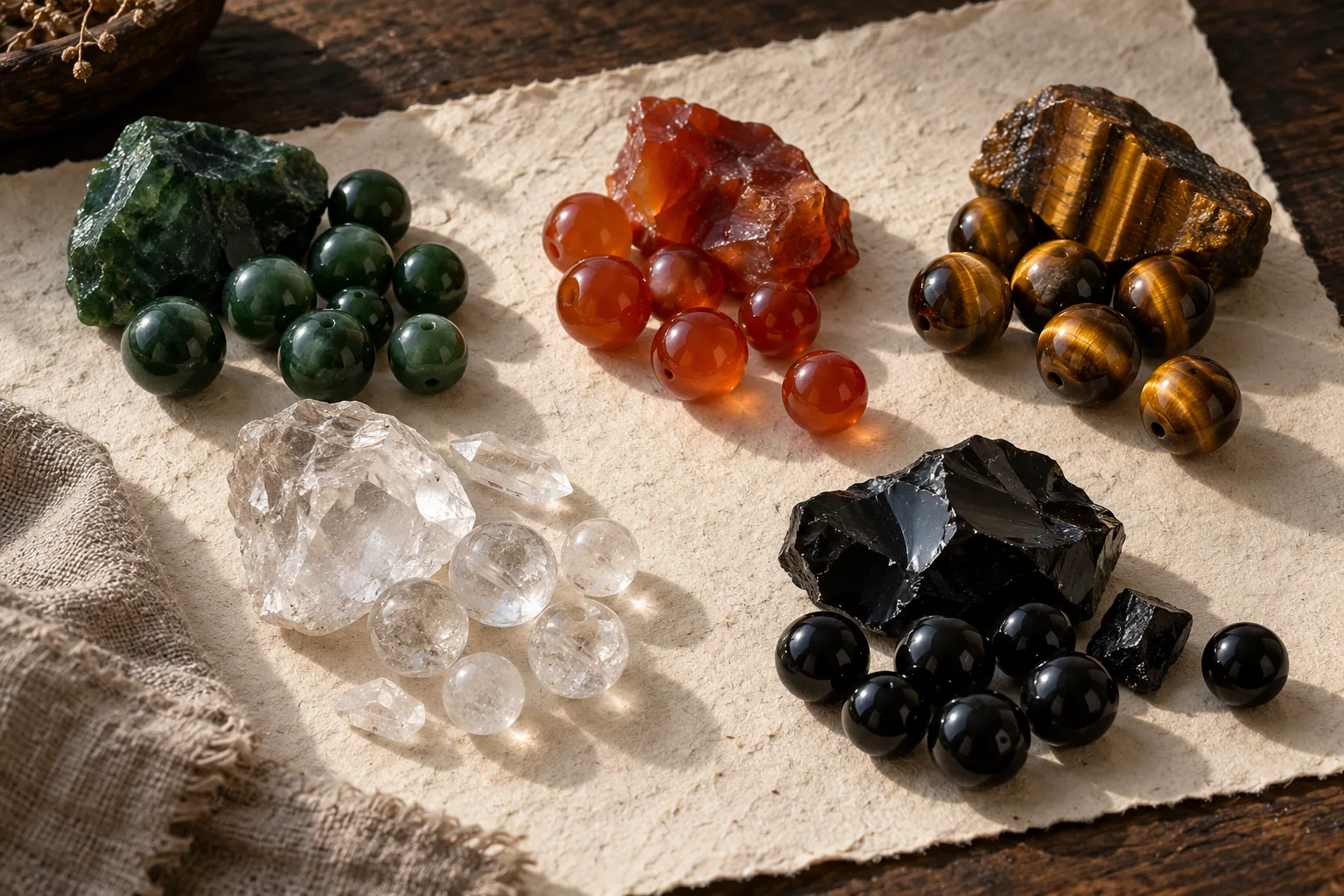
Common correspondences associate green or qing tones with Wood, red with Fire, yellow and earthy tones with Earth, white with Metal and black with Water. Traditional qing terminology does not divide blue and green exactly as every modern product palette does, and design practices can vary.
The brand uses color and material appearance to express wishes: aventurine for growth, carnelian for celebration, yellow jasper for home, white agate for harmony and obsidian for protection. A mixed design takes its theme from the whole composition rather than one isolated bead.
Material identity remains a separate practical question. Similar colors may belong to different stones, and cultural meaning does not replace composition, specifications or care information.
Making a personal choice
You can choose a ready-to-wear Five Elements theme for an intention you enjoy without first fitting yourself to a percentage chart. Personal design uses birth details and a stated interpretation method to discuss favorable elements, then relates them to annual wishes and preferences.
Materials, bead diameter and wrist fit remain real wearing choices. A composition guided by the chart’s energy pattern can still respect the wearer’s color, texture and everyday preferences.
Questions & answers
Can a Five Elements enquiry use only a name?
Name-character classification and birth-chart distribution are different questions with different methods and inputs. Identify which one a service or tool is answering.
Is a chart automatically better with all five elements present?
Presence is a distribution description, not a complete evaluation. Relationships, season and the interpretation method still matter.
Does wearing a color fill a missing element?
Color can express a Five Elements intention. Personal favorable-element design requires a fuller basis rather than literally filling a numerical gap with colored objects.