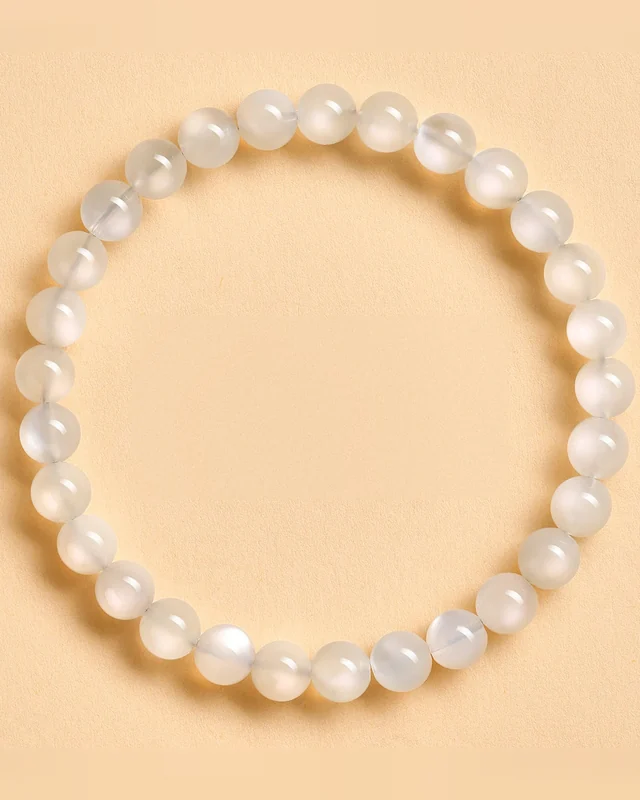
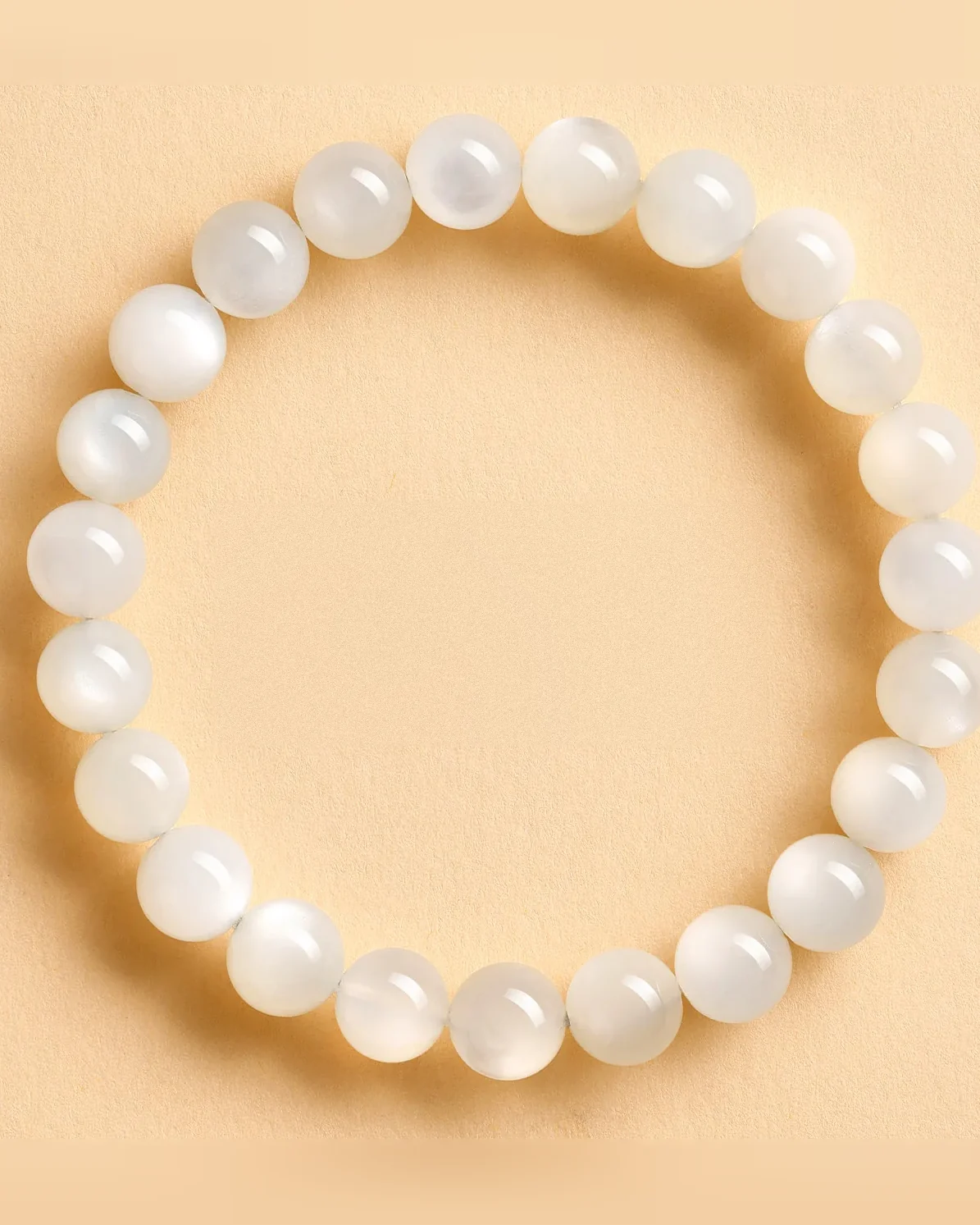
 View larger
White moonstone8 mm
Auspicious bracelets / Metal
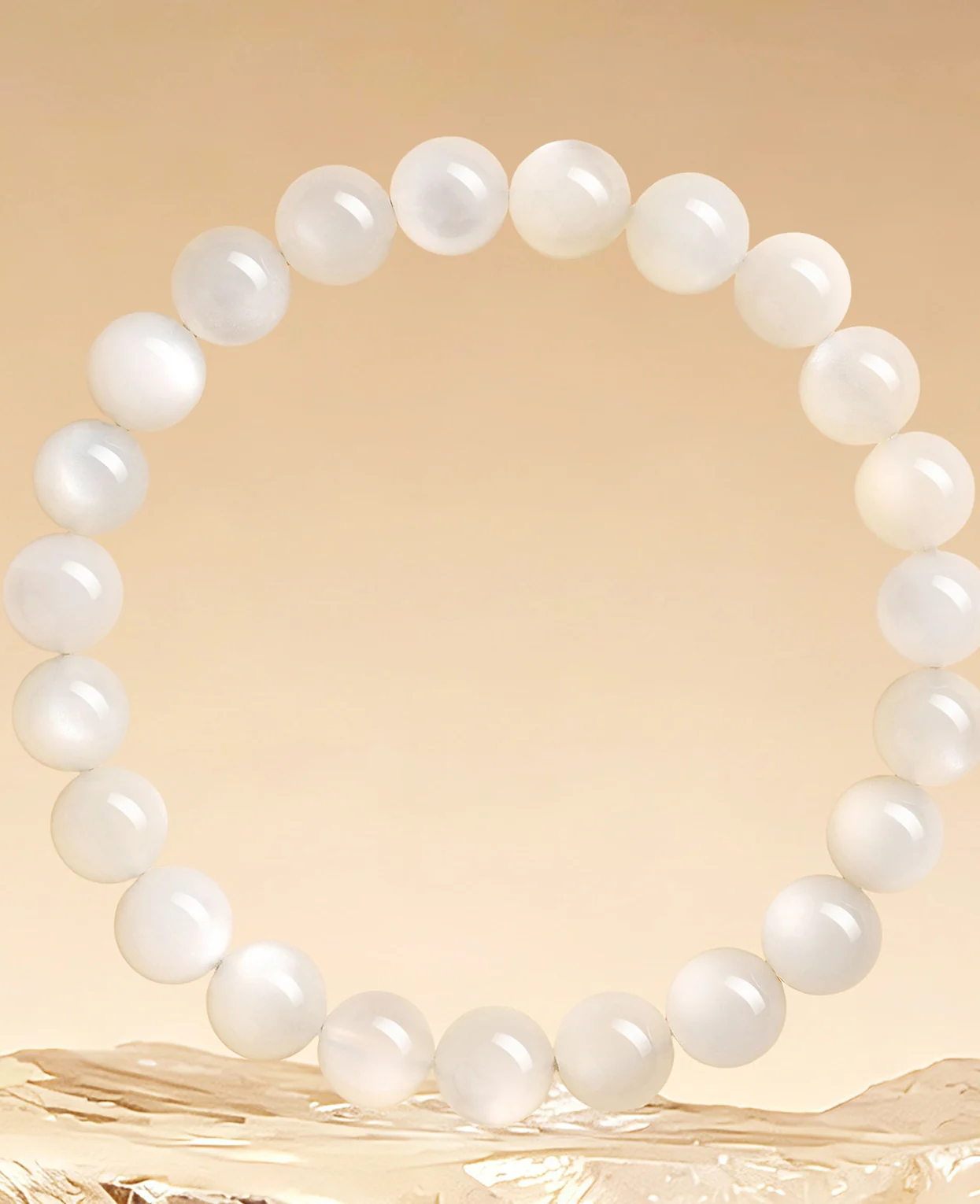
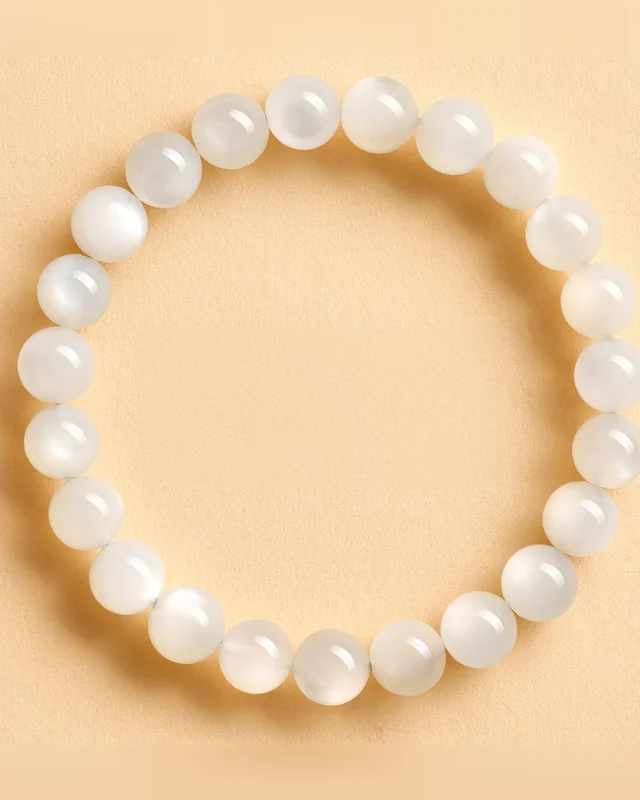
8 mm Moonstone Bracelet · Full-Moon Harmony
Collector-grade Sri Lankan white moonstone in 8 mm rounds, each with a soft glow that drifts across the surface like moonlight.
$98.00USD
- Gemstones & materials
- White moonstone (feldspar)
- Grade
- Collector grade: translucent body with visible floating sheen
- Bead shape & size
- Round, approximately 8 mm
- Origin
- Sri Lankan moonstone
- Certification
- Supplied with an identification certificate
- Style
- WX033
Prepared in 5 days after payment
Shipping: Asia $10; Europe, US, Canada, Australia & NZ $20
Ready-designed returns may be requested within 14 days. See returns policy
Full-Moon Harmony
A soft glow, like moonlight on water
Full-Moon Harmony is a strand of white moonstone from Sri Lanka, each round bead approximately 8 mm across. Moonstone has a quality unlike any other gem: a soft, milky glow, called adularescence, that seems to float just beneath the surface and drift as the bead turns, like moonlight on a still lake. In collector-grade beads like these, the body is translucent and clean, and the glow catches a faint blue at certain angles.
White belongs to Metal in the Five Elements, and in Chinese culture the full moon is the symbol of reunion and completeness. The Chinese name, yueyuan heyuan, wishes for affection, harmony and the joy of loved ones gathered together. It is a natural gift for an anniversary, a family reunion or anyone drawn to pale, luminous stones.
- Round white moonstone beads, approximately 8 mm, Sri Lankan material.
- Collector grade: translucent body with a visible floating sheen.
- Supplied with an identification certificate.
- Wrist sizes from 14 to 21 cm, with the bead count adjusted to your size.
Full-Moon Harmony
Full-Moon Harmony in detail
What moonstone is, where its glow comes from, why Sri Lankan material is prized, and how to choose and care for it.
01
Moonstone, the feldspar with a glow
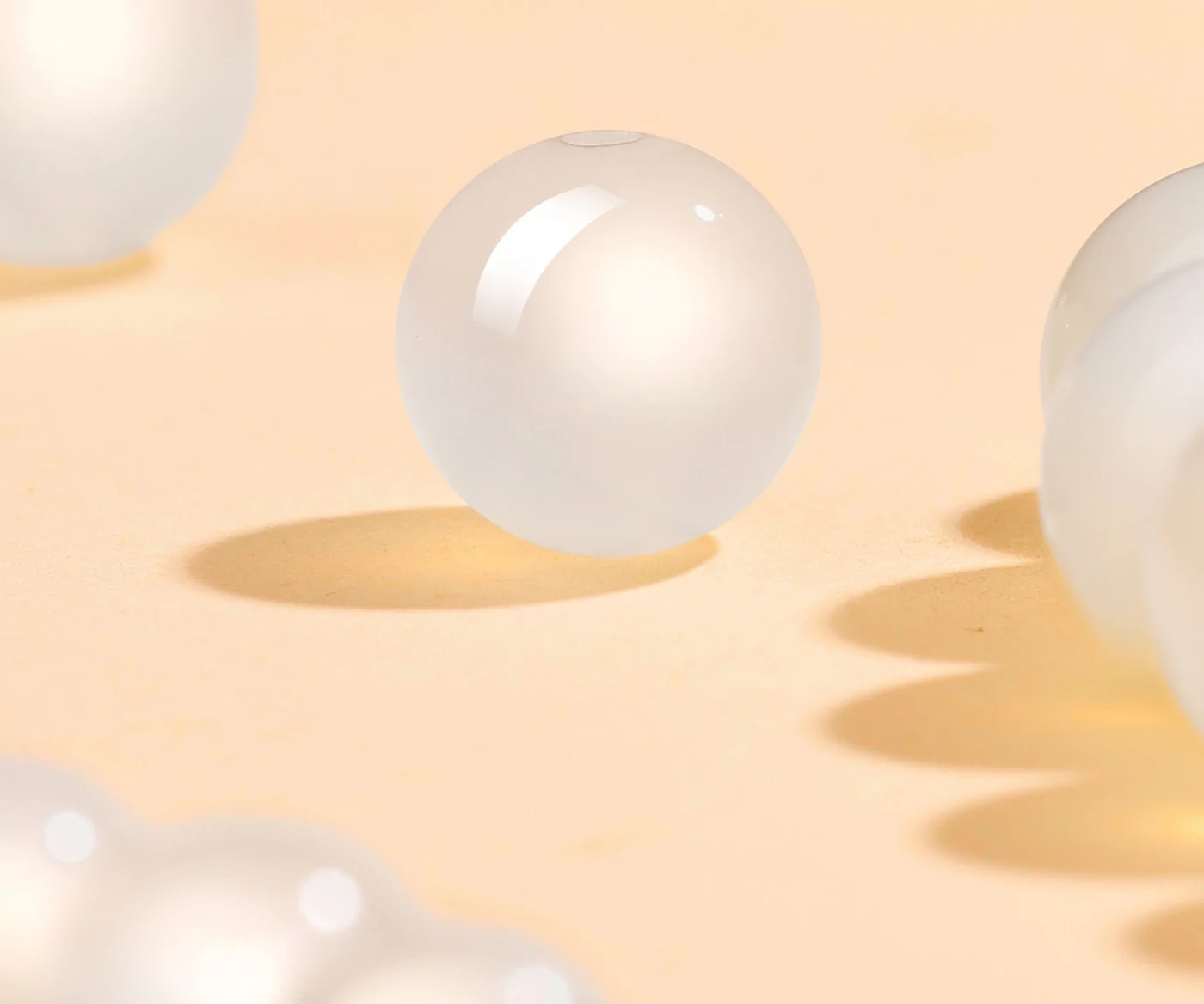
Moonstone is a variety of feldspar, the most abundant mineral family in the Earth’s crust. Most feldspar is ordinary rock-forming material, but in moonstone two kinds of feldspar, orthoclase and albite, separated into ultra-thin alternating layers as the crystal cooled. Those layers, each thinner than the wavelength of light, scatter light in a way that produces moonstone’s famous glow.
Moonstone is moderately hard, at about 6 to 6.5 on the Mohs scale, and like all feldspars it has cleavage: planes along which it can split if struck sharply. It is perfectly durable for a bracelet with sensible care, but it is a gentler stone than quartz, best kept away from hard knocks.
Moonstone has been admired for millennia. The Romans believed it was formed from solidified moonlight; in India it was considered sacred; and in the early twentieth century it became a favourite of Art Nouveau jewellers. It is also the traditional birthstone for June.
02
Adularescence: the floating light
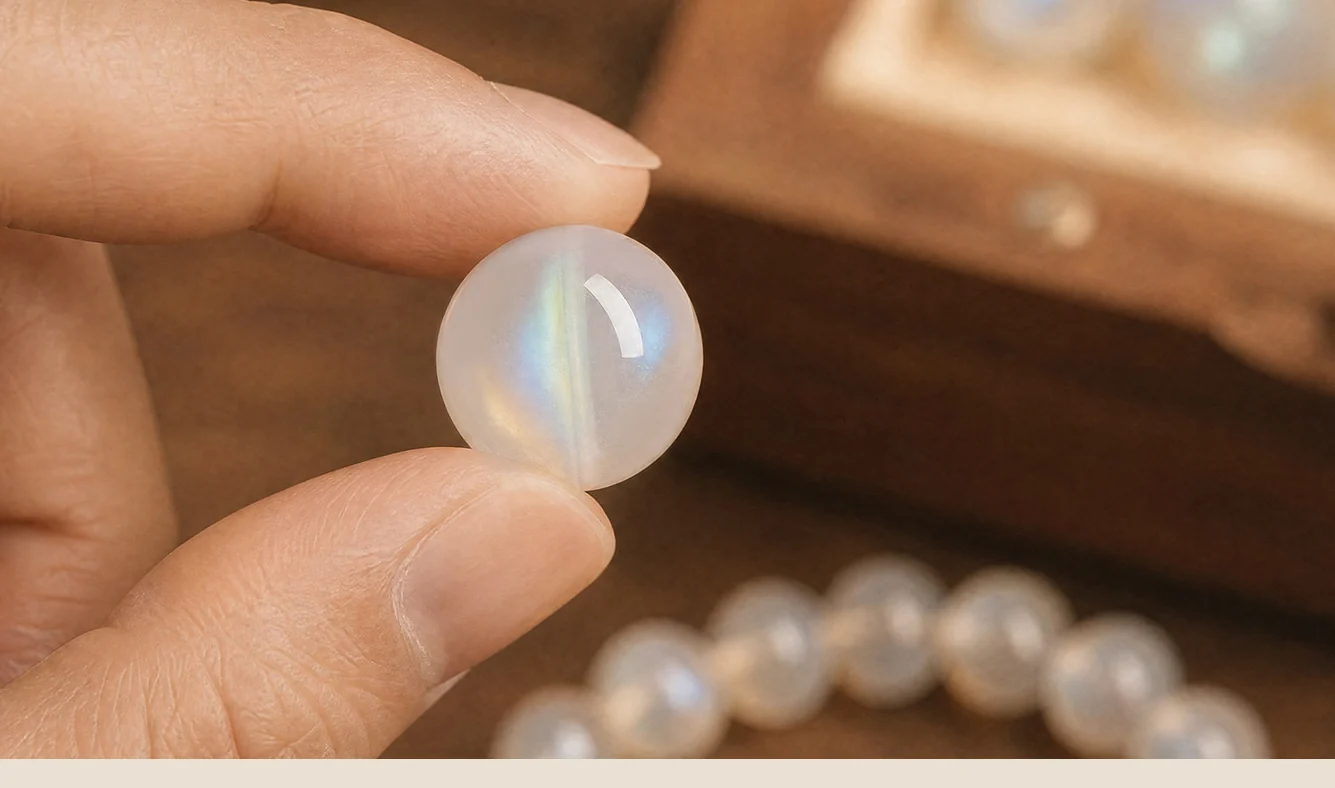
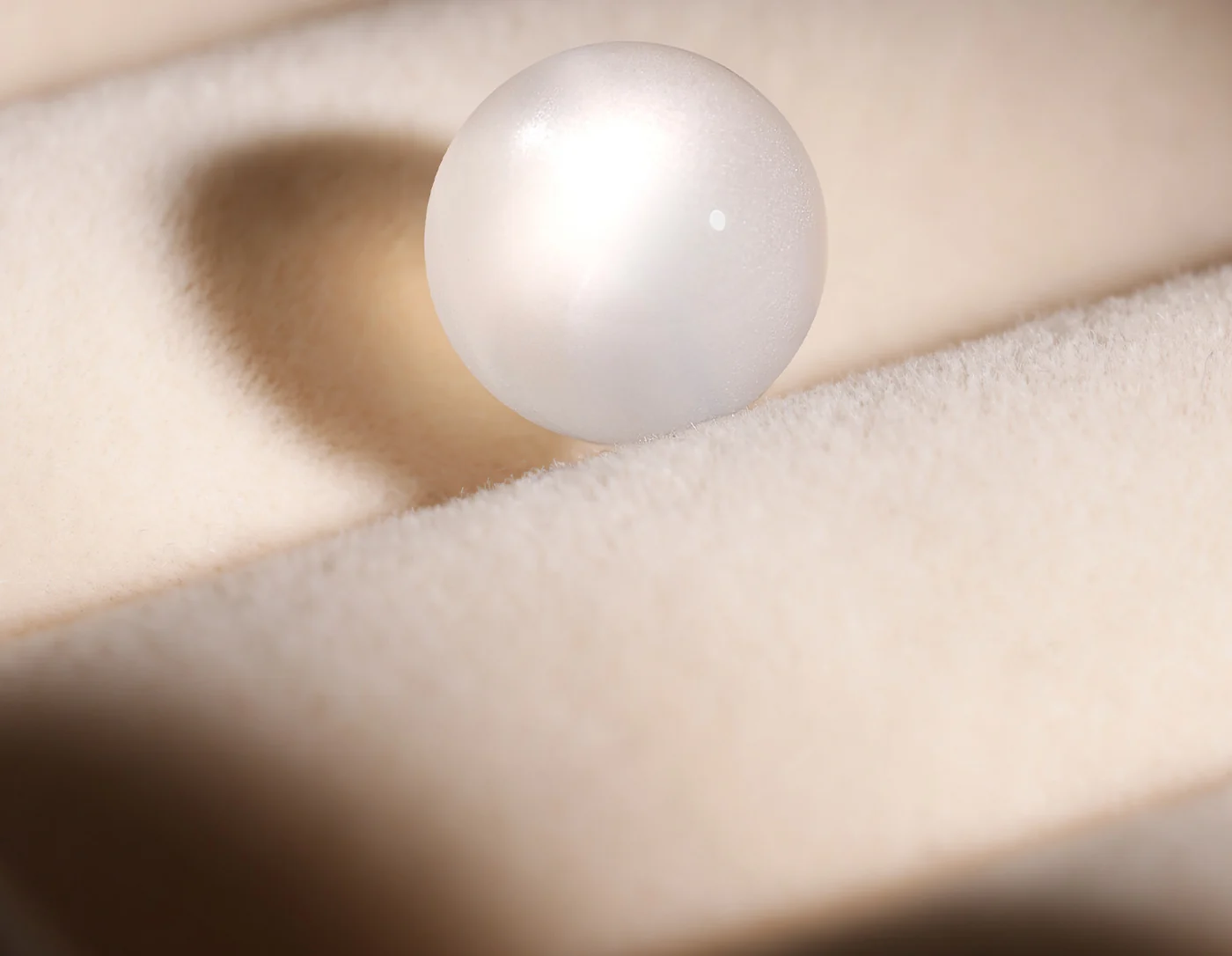
The glow in moonstone has its own name: adularescence, after the Adula mountains in Switzerland where a form of the mineral was described. Unlike the sharp sparkle of a faceted gem, it is a soft, diffuse sheen that appears to hover inside the stone. As you move a bead, the glow glides across it, brightening and fading.
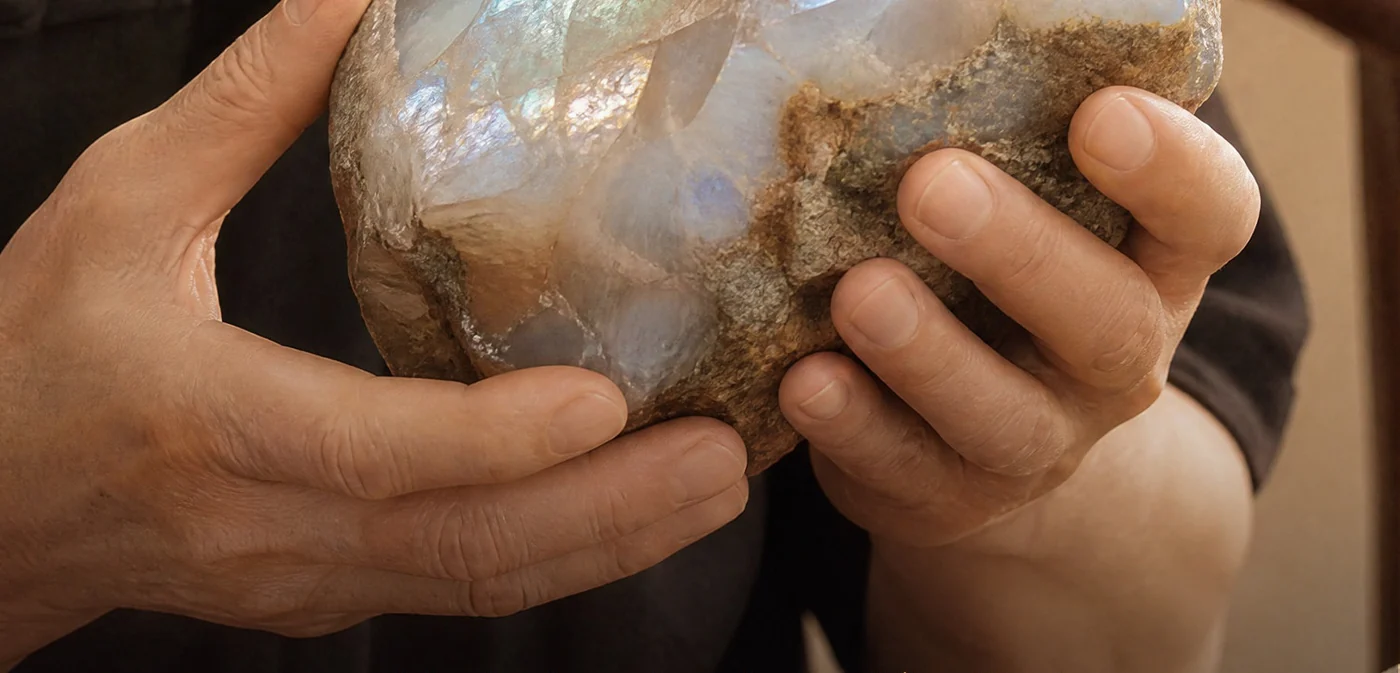
In fine moonstone the sheen can carry a blue tint, especially in Sri Lankan material, as the photograph of the single bead shows. White moonstone, used here, has a predominantly silvery-white glow with flashes of blue at certain angles, set in a translucent, slightly milky body.
Round beads show adularescence beautifully because their curved surfaces always present some angle that catches the light. On the wrist, a strand of moonstone seems to shimmer gently with every movement.
03
Sri Lankan moonstone
Sri Lanka has been the classic source of fine moonstone for centuries. The gem gravels around Meetiyagoda, in the south-west of the island, produced the famous blue-sheen moonstones that set the standard for the world. Today, Sri Lankan material remains prized for its clean, translucent body and strong, even glow.
Our supplier sources its white moonstone from Sri Lanka and grades the beads in this bracelet among its top category, which it calls “10A”: translucent, with few visible inclusions and a clear floating sheen. Rough moonstone is examined by hand before cutting, because the direction of the internal layers determines where the glow will appear on the finished bead.
Each strand is supplied with an identification certificate from a third-party gem laboratory.
04
Cutting for the glow
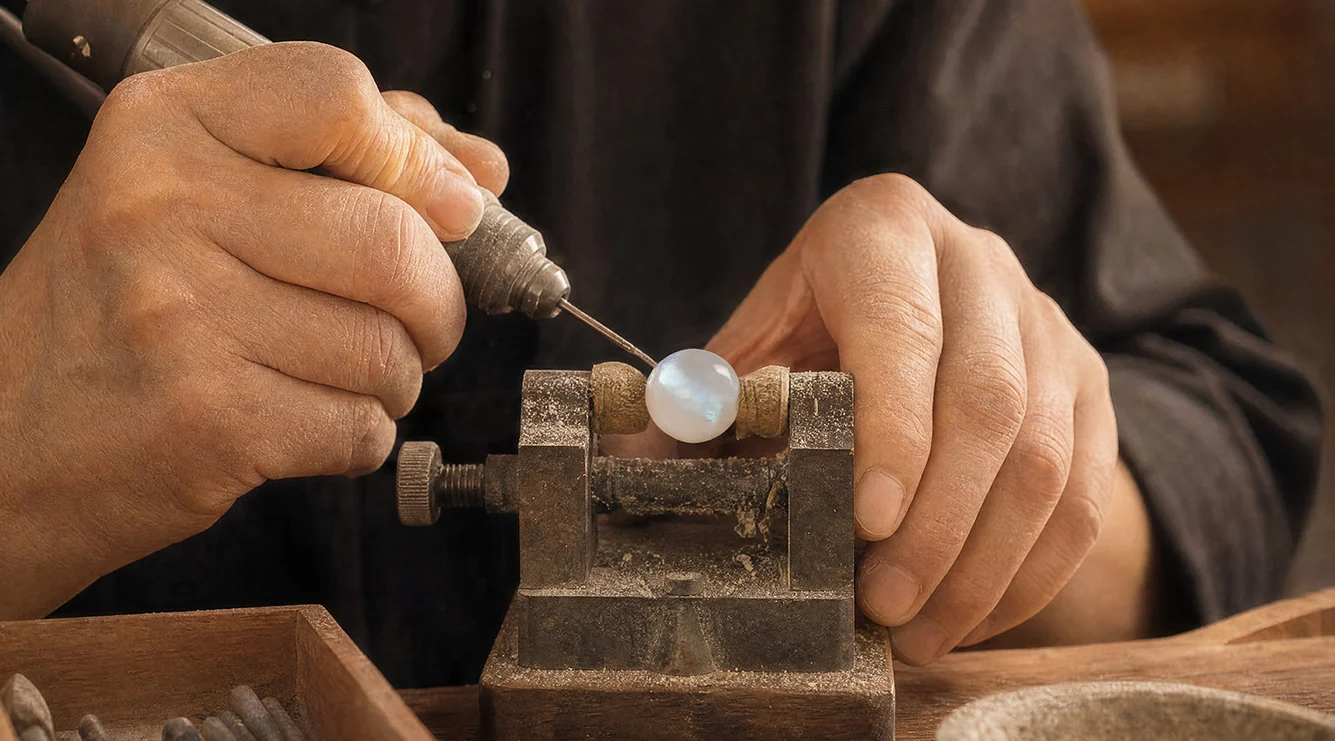
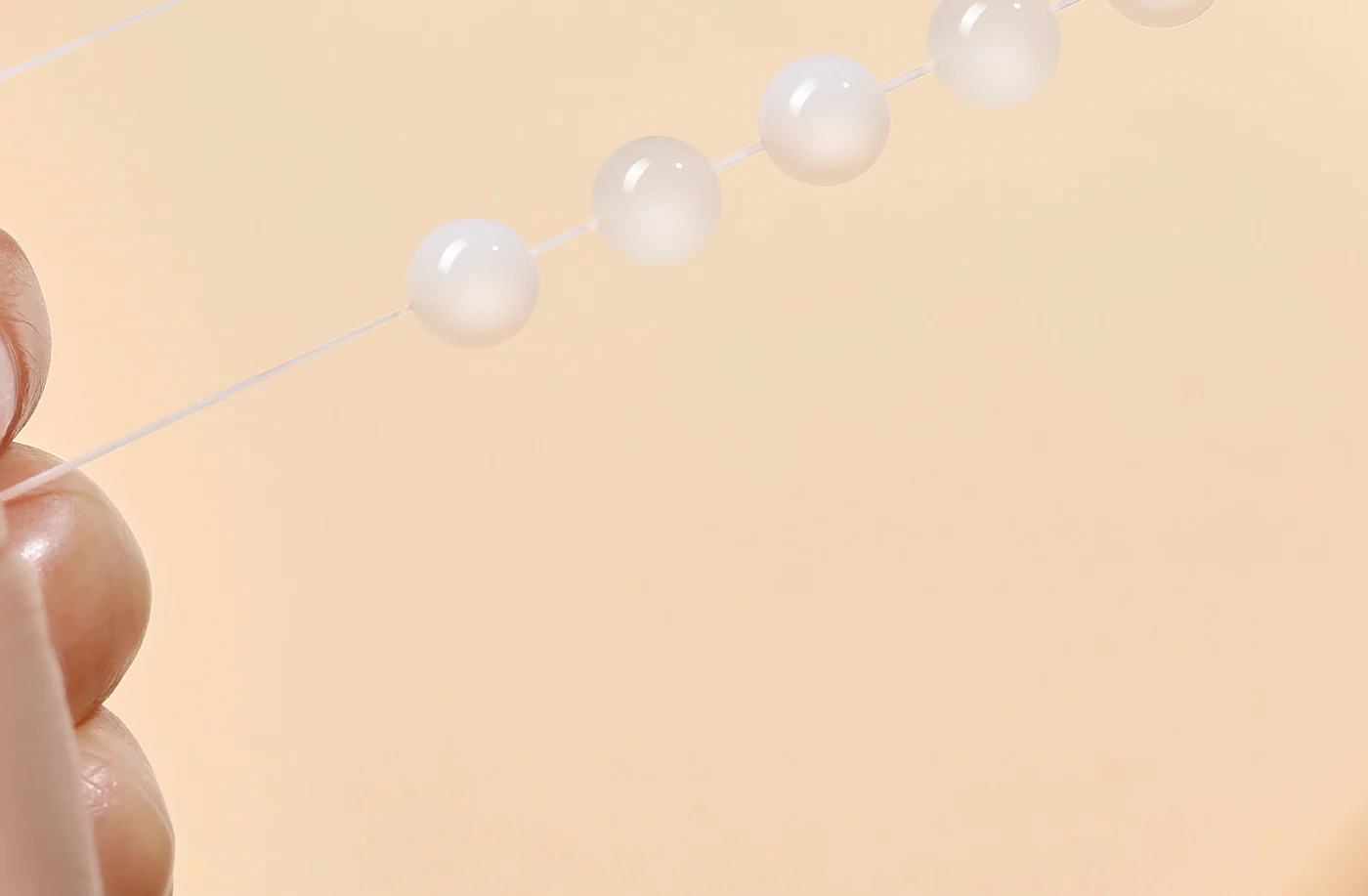
Cutting moonstone well requires experience. The craftsman must orient each piece so that the glow sits in the right place and avoid striking along the cleavage planes, which can split the stone. The rough is sawn gently into cubes, ground into rounds, drilled with care and polished in several stages until the surface is smooth and lustrous.
After polishing, each bead is checked under light for cracks, cloudiness and the quality of its sheen. Our supplier reports rejecting more than half of the beads at this stage. The remaining beads are matched by tone and glow so the strand looks even.
05
Why 8 mm
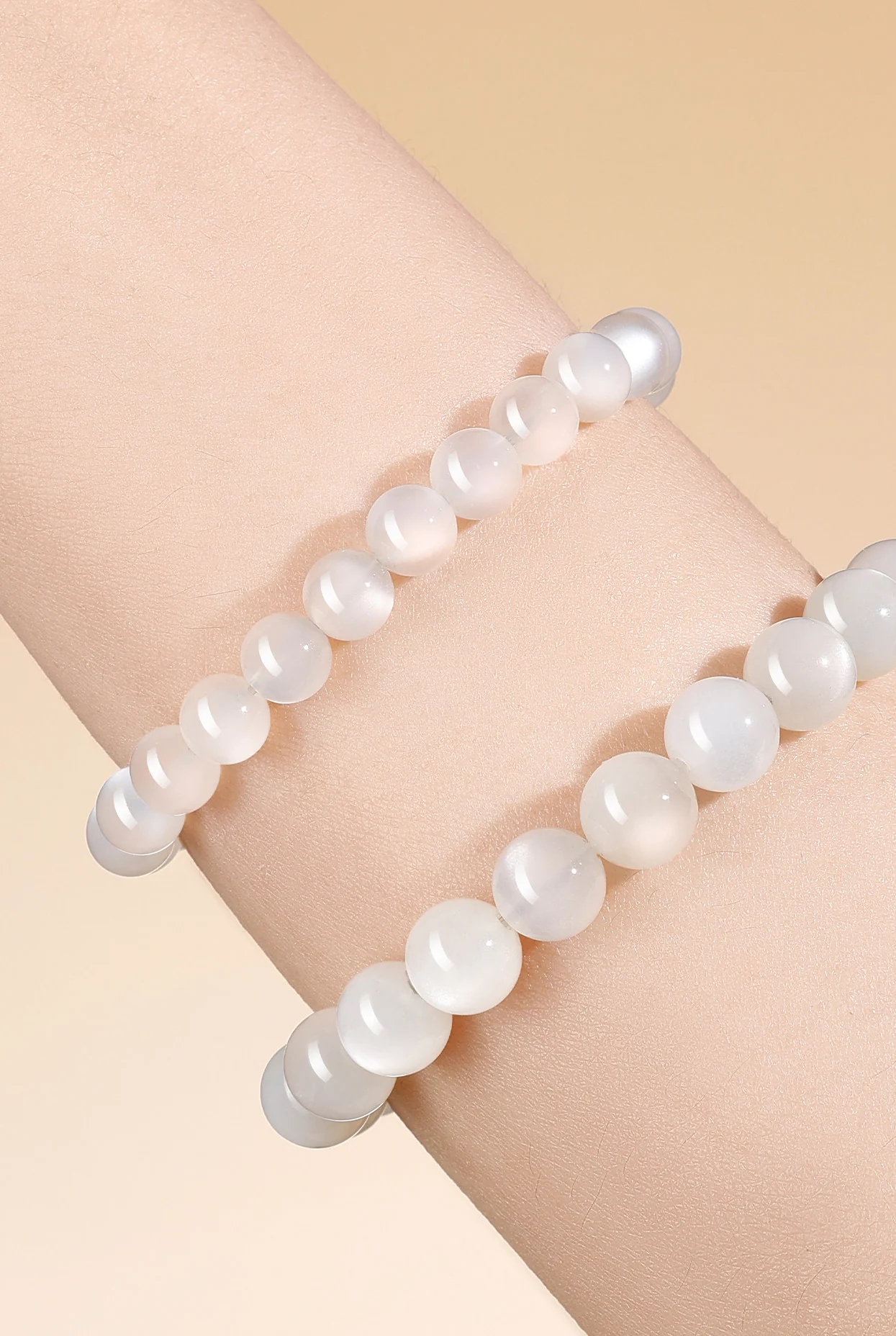
Moonstone is offered from fine 6 mm beads to 12 mm. At 6 mm a strand is delicate and dewy; at 8 mm each bead is large enough to show its floating glow clearly while the bracelet stays light and refined; at 10 mm and above it becomes a fuller, more prominent band.
Full-Moon Harmony uses 8 mm as the balanced everyday size. It suits most wrists, sits comfortably under a cuff and pairs easily with a watch or other bracelets. For a finer look, compare the 6 mm Simple Blessings design in the same moonstone.
| Bead diameter | How moonstone looks | Often chosen for |
|---|---|---|
| 6 mm | Delicate, dewy sparkle | Slender wrists, stacking; see Simple Blessings |
| 8 mm · this design | Clear floating glow in a balanced strand | Everyday wear and gifts; most wrists |
| 10–12 mm | Fuller, more dramatic sheen | Wearing one statement strand |
06
Choosing your wrist size
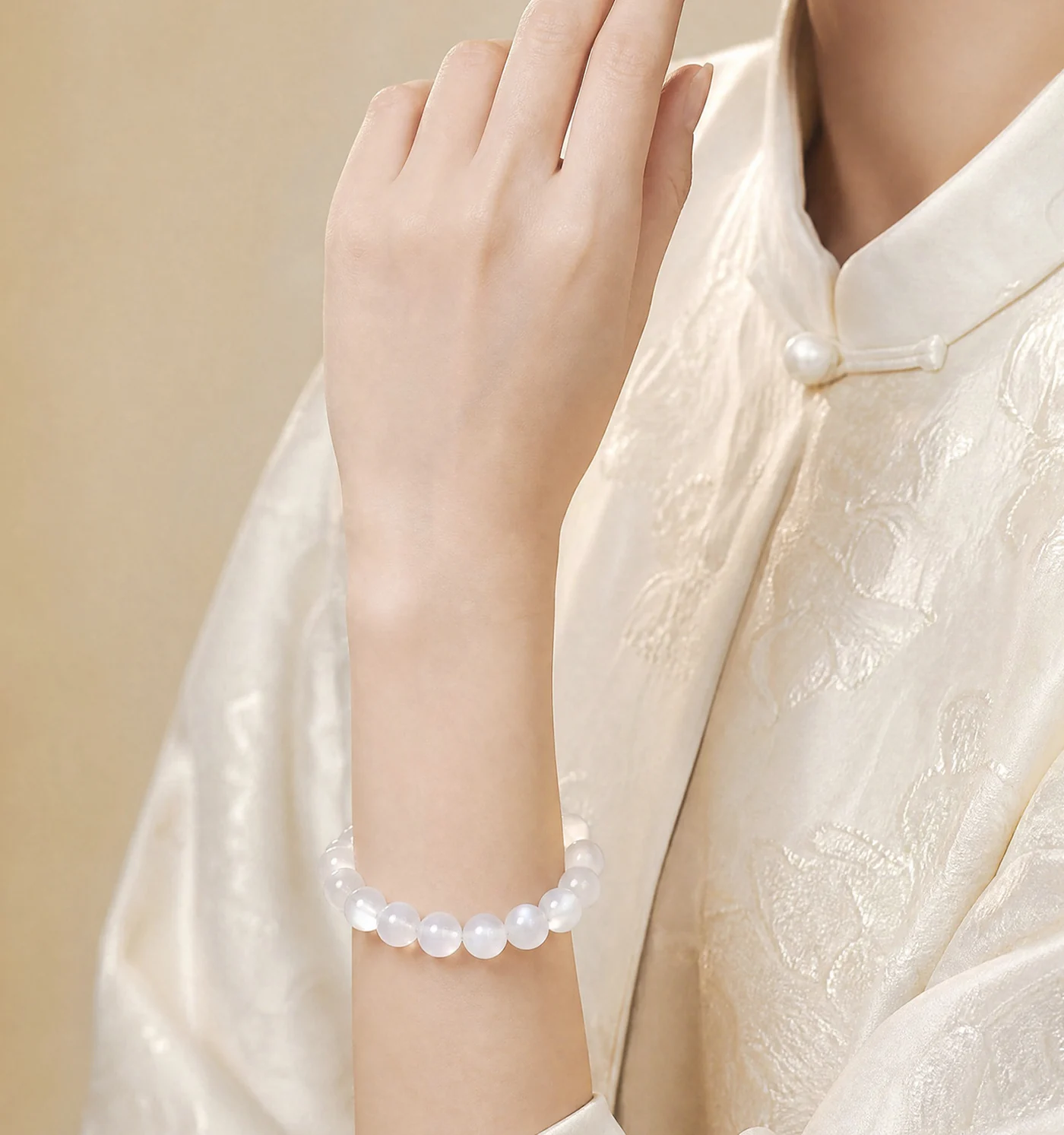
Measure the wrist itself with a soft tape or paper strip, just above the wrist bone where you usually wear a bracelet. Keep it snug without squeezing and choose that measurement on this page. The strand is made with a small allowance so that it moves slightly and stays comfortable.
The table shows typical bead counts for 8 mm moonstone. Your bracelet may differ by one bead, as natural beads vary fractionally and each strand is checked against the measurement when it is strung.
Between two sizes, choose the larger for a relaxed fit or the smaller for a closer one. Roll the strand over the knuckles rather than stretching it.
| Wrist size | Approximate inches | Typical bead count (8 mm) |
|---|---|---|
| 14 cm | 5.5 in | 22 beads |
| 15 cm | 5.9 in | 23 beads |
| 16 cm | 6.3 in | 24 beads |
| 17 cm | 6.7 in | 25 beads |
| 18 cm | 7.1 in | 27 beads |
| 19 cm | 7.5 in | 28 beads |
| 20 cm | 7.9 in | 29 beads |
| 21 cm | 8.3 in | 30 beads |
07
The full moon and reunion
In Chinese culture the full moon, yueyuan, is the image of completeness and reunion. Its roundness mirrors the round table at which a family gathers, and the phrase tuan yuan, “reunion”, is built on the same idea. When the moon is full, people far apart are said to look up at the same moon and think of one another.
The Chinese name of this design joins yueyuan with heyuan, harmonious affinity: a wish for loving relationships, mutual understanding and the happiness of being together. Moonstone, with its gentle, lunar glow, is a natural stone for that wish.
These are cultural meanings and personal wishes rather than promises.
08
White, Metal and the moon
In the Five Elements, white belongs to Metal, the element of autumn and the west. Autumn is also the season of the brightest full moon, celebrated at the Mid-Autumn Festival, so white moonstone links naturally to both. Metal is associated with clarity, refinement and calm resolve, and in Chinese tradition with the qualities of righteousness and integrity.
Moonstone’s soft light gives Metal a gentler expression than clear quartz: less sharp, more tender. Many people choose it for emotional steadiness, as a reminder to stay calm and kind.
If you would like a design based on your own birth chart, a personal design begins with a fuller BaZi discussion.
09
The Mid-Autumn Festival
On the fifteenth day of the eighth lunar month, when the moon is at its fullest and brightest, Chinese families gather for the Mid-Autumn Festival. They share mooncakes, admire the moon and tell the story of Chang’e, who drank an elixir of immortality and floated to the moon, where she lives with a jade rabbit. For those who cannot be home, the shared moon is a symbol of connection across distance.
Poets have written about the moon at Mid-Autumn for well over a thousand years. Su Shi’s famous lines, written while separated from his brother, end with the wish that loved ones may live long and share the moon’s beauty though a thousand miles apart, a sentiment many families still quote today.
Full-Moon Harmony is a popular Mid-Autumn gift for that reason: a piece of moonlight to wear, given by someone who wishes they could be together. It is equally meaningful at Lunar New Year reunions or a wedding anniversary.
10
Wearing white moonstone
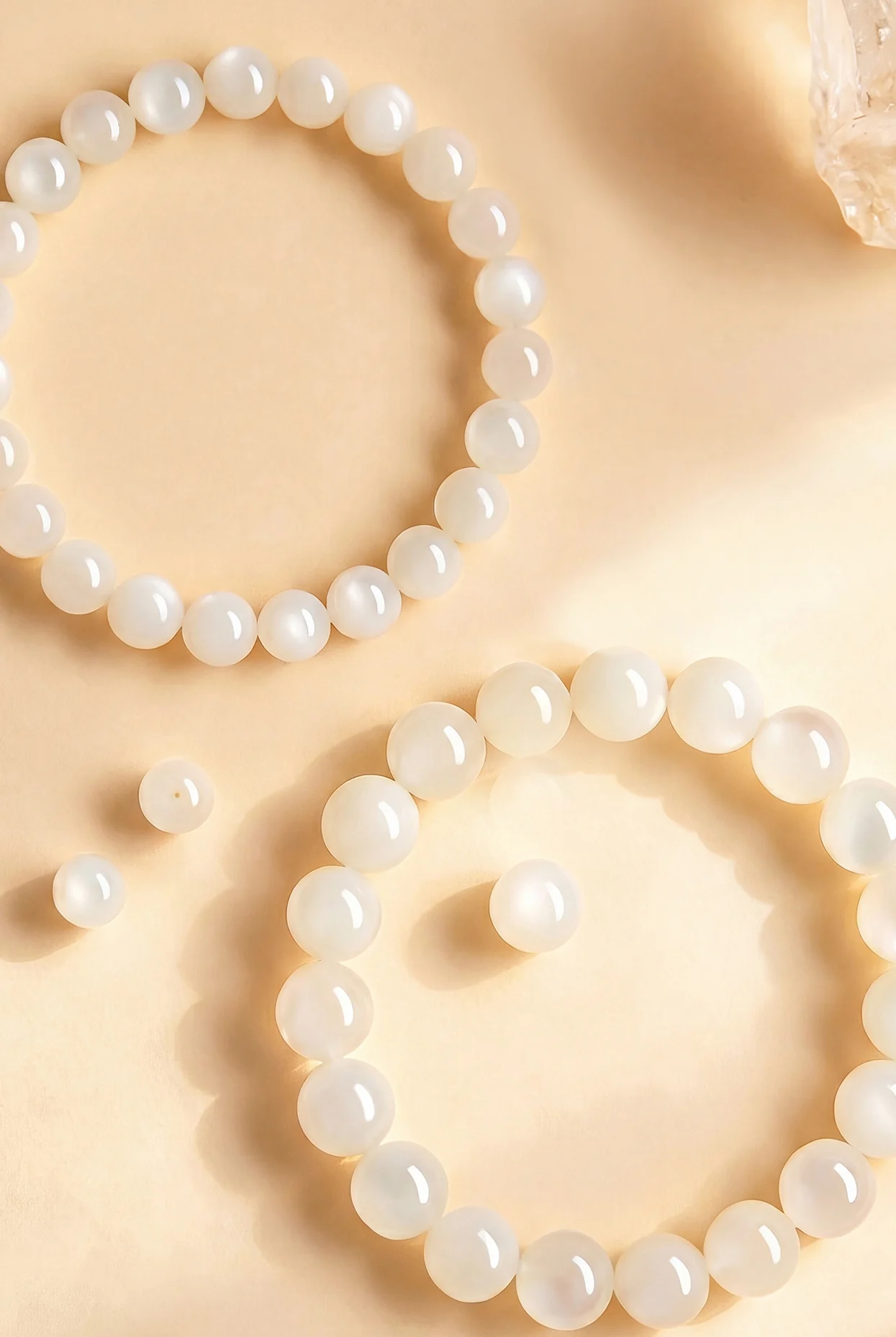
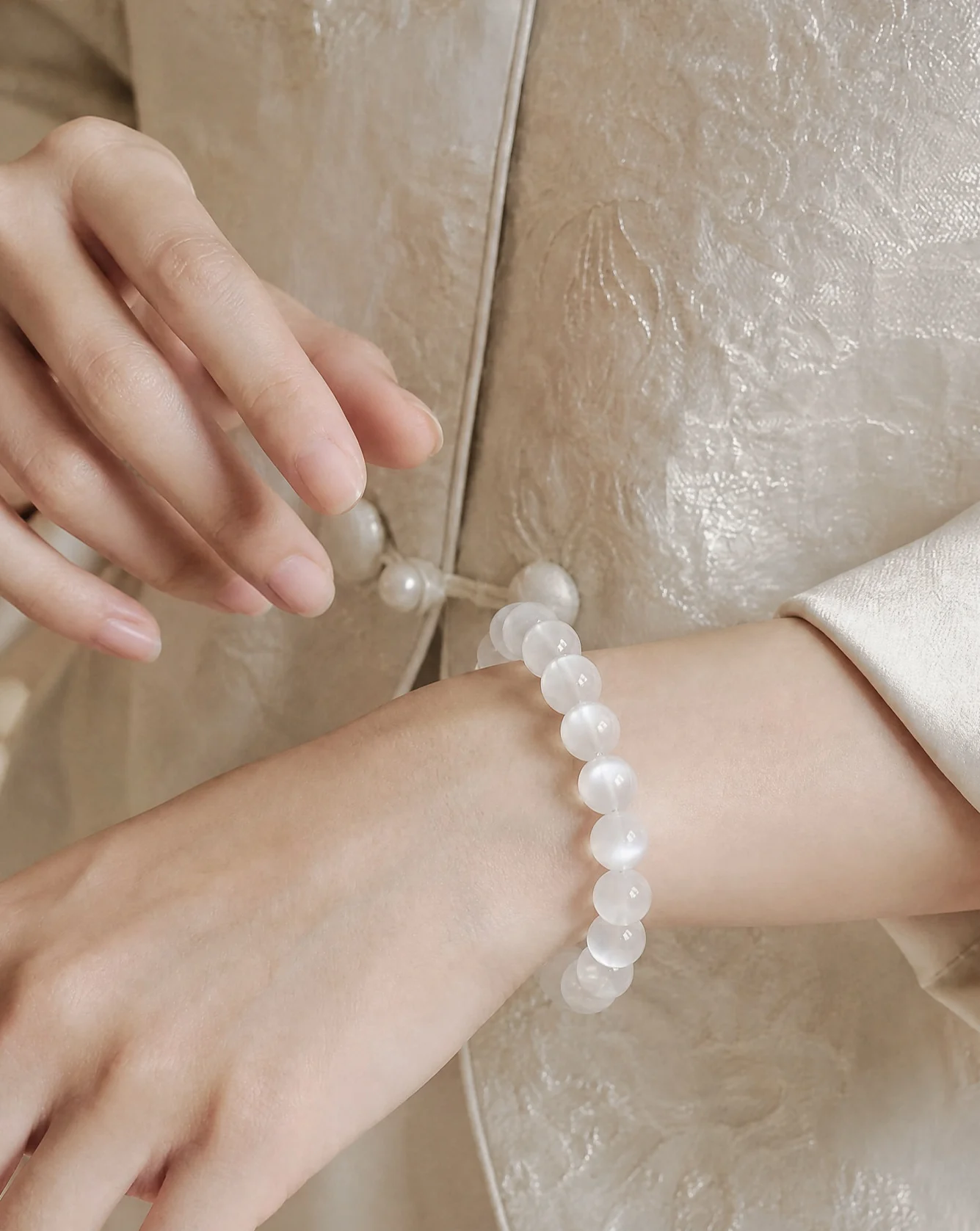
White moonstone is delicate and versatile. It looks luminous against ivory, cream and pale grey, as the photographs show, and striking against navy, black or deep green. It pairs beautifully with silver and white gold, which echo its cool glow, and softly with rose gold.
At 8 mm, the strand works alone or with one slim companion piece. It stacks naturally with a pale jade or clear quartz bracelet for an all-light look, or with a deep blue lapis or aquamarine strand for a moonlit-night palette. It is unisex, though most often worn by women.
11
White, grey and blue moonstone
Moonstone comes in several body colours. White moonstone, used here, has a translucent white body with a silvery-blue glow. Grey moonstone has a smoky body against which a blue flash stands out dramatically. Blue moonstone, the rarest and most expensive, shows a strong, vivid blue sheen across the whole bead. Peach and rainbow moonstones are related materials with warm or multicoloured sheen.
White moonstone is the most classic and easiest to wear: soft, bright and harmonious with almost anything.
Body colour also affects how the glow reads. Against a white body, the sheen looks soft and silvery, like a cloud lit by the moon; against grey, it looks sharper and bluer, like moonlight on dark water. Neither is better, they simply suit different moods.
12
Moonstone, clear quartz and white jade
Our white bracelets each have their own character. Clear quartz is transparent and sparkling, like water. White jade is opaque, creamy and waxy. Moonstone sits between them: translucent rather than transparent, with a floating glow that neither of the others has. Choose moonstone if you love gentle shimmer and a soft, lunar mood.
13
A gift of reunion
Full-Moon Harmony suits anniversaries, the Mid-Autumn Festival, family reunions and birthdays in June, the month of moonstone. It is also a gentle, meaningful gift between partners or close friends who live apart.
A short note about the full moon and reunion makes the gift personal. If you cannot measure the recipient’s wrist, choose the most likely size; an unworn ready-designed bracelet can be returned within 14 days of delivery.
14
Recognising natural moonstone
Natural moonstone’s glow moves as you turn the bead and appears to sit inside the stone. Imitations made of glass, often called “opalite”, have a bluish milky glow that looks uniform from every angle and often show tiny bubbles. Natural moonstone may also show small internal features, such as fine “centipede” inclusions, a characteristic of feldspar.
The most reliable confirmation is a laboratory report, which is why each strand comes with an identification certificate.
15
Care for a gentle stone
Moonstone is softer than quartz and has cleavage, so give it a little care. Take it off for sport, gardening and heavy work, and avoid knocking it against stone or metal. Store it on its own in a soft pouch, away from harder gems that could scratch it.
Wipe the beads with a soft cloth; avoid ultrasonic cleaners, steam, sudden temperature changes and household chemicals. Remove the bracelet before swimming and bathing. With daily wear, stranded elastic usually lasts one to two years; if gaps appear between the beads, have it restrung before it breaks.
Questions & answers
Is this natural moonstone?
Yes. The beads are natural Sri Lankan moonstone, supplied with an identification certificate.
What causes the glow?
Ultra-thin layers of two feldspars inside the stone scatter light, producing a floating sheen called adularescence.
Will every bead show a blue flash?
White moonstone shows mainly a silvery glow, with blue at certain angles. The strength varies from bead to bead.
Is moonstone fragile?
It is softer than quartz and can split if struck hard, but with sensible care it is durable for everyday wear.
Is moonstone the June birthstone?
Yes. Moonstone is one of the traditional birthstones for June.
How many beads will my bracelet have?
Typically 22 beads for a 14 cm wrist, rising to about 30 for 21 cm.
What is the difference from Simple Blessings?
Both use the same white moonstone. Full-Moon Harmony uses 8 mm beads; Simple Blessings uses finer 6 mm beads.
Which element is moonstone?
White moonstone is associated with Metal in the Five Elements.
How can I tell it from opalite?
Opalite is glass with a uniform blue glow and often bubbles; moonstone’s glow moves and appears to sit inside the stone.
Is it suitable for men?
Yes, though it is most often worn by women. The 8 mm size is understated enough for anyone.
Can I shower or swim with it?
It is best not to. Soap, chlorine and soaking weaken the elastic and can dull moonstone’s surface.
Will it fade?
No. Moonstone’s glow is structural and does not fade with wear.
Can I stack it with other bracelets?
Yes. It pairs well with jade, clear quartz and blue stones; avoid stacking it with hard metal bangles.
Does moonstone need cleansing?
No special ritual is needed. If you enjoy one, avoid salt and soaking; moonlight is a gentle traditional choice.
Which wrist should I wear it on?
Whichever is most comfortable; some people prefer the left wrist for stones associated with love.
Will it look exactly like the photographs?
The grade and size match, though the glow varies naturally from bead to bead and with the lighting.
Compare sizes and arrangements in this material
Compare the material, bead shape and size to choose the arrangement that fits your style.
| Design | Materials | Bead shape & size | Ordering |
|---|---|---|---|
 8 mm Moonstone Bracelet · Full-Moon HarmonyThis design | White moonstone | 8 mm | $98.00 USD |
| 6 mm Moonstone Bracelet · Simple Blessings | White moonstone | 6 mm | $56.00 USD |
Know the materials in this bracelet
Compare these related designs
Balance · Wisdom
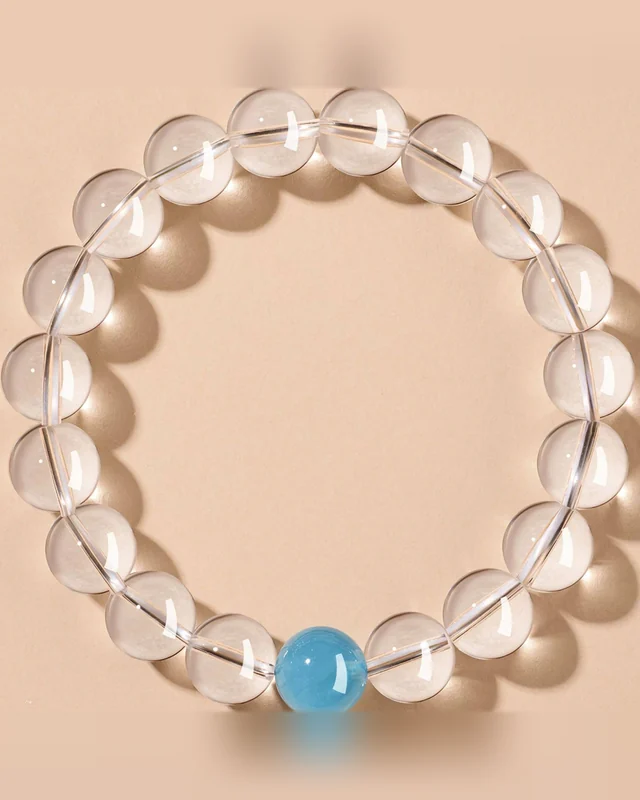
8 mm Clear Quartz Bracelet · Clear Intention
Clear quartz · Aquamarine
$76.008 mm · Metal
Protection · Balance
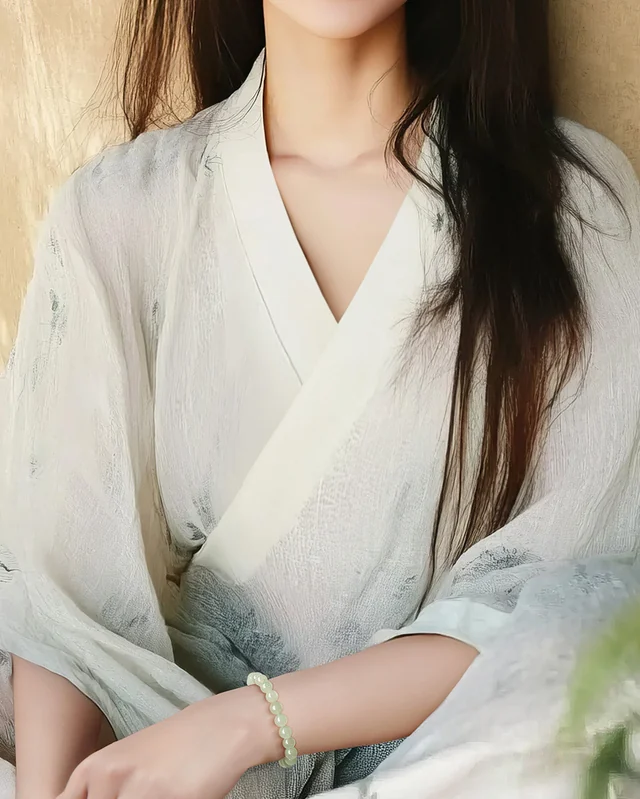
8 mm Hetian Jade Bracelet · Jade Blessings
Hetian jade (nephrite)
$128.008 mm · Wood
 Personal designs
Harmony · Balance
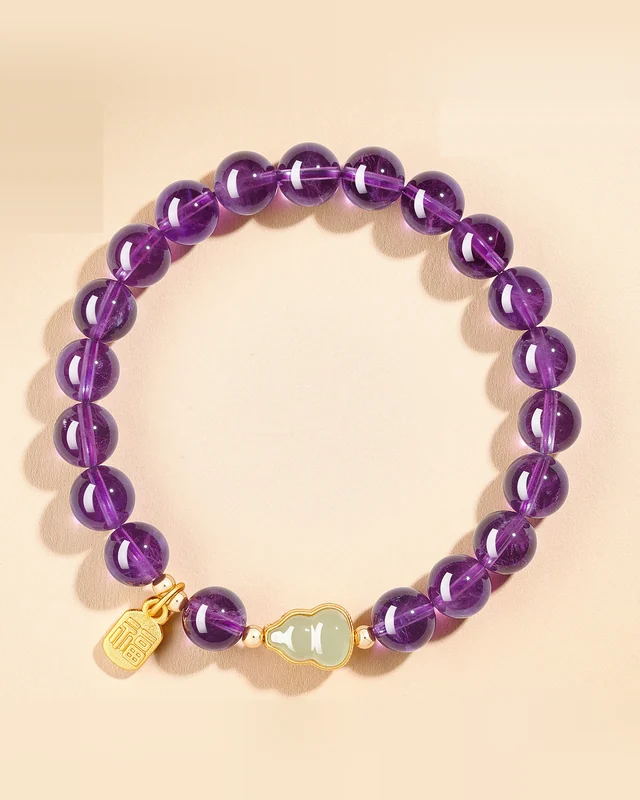
Custom Amethyst and Jade Gourd Bracelet · Metal Harmony
Amethyst · Nephrite jade
Quoted after we confirm your design8 mm · Metal