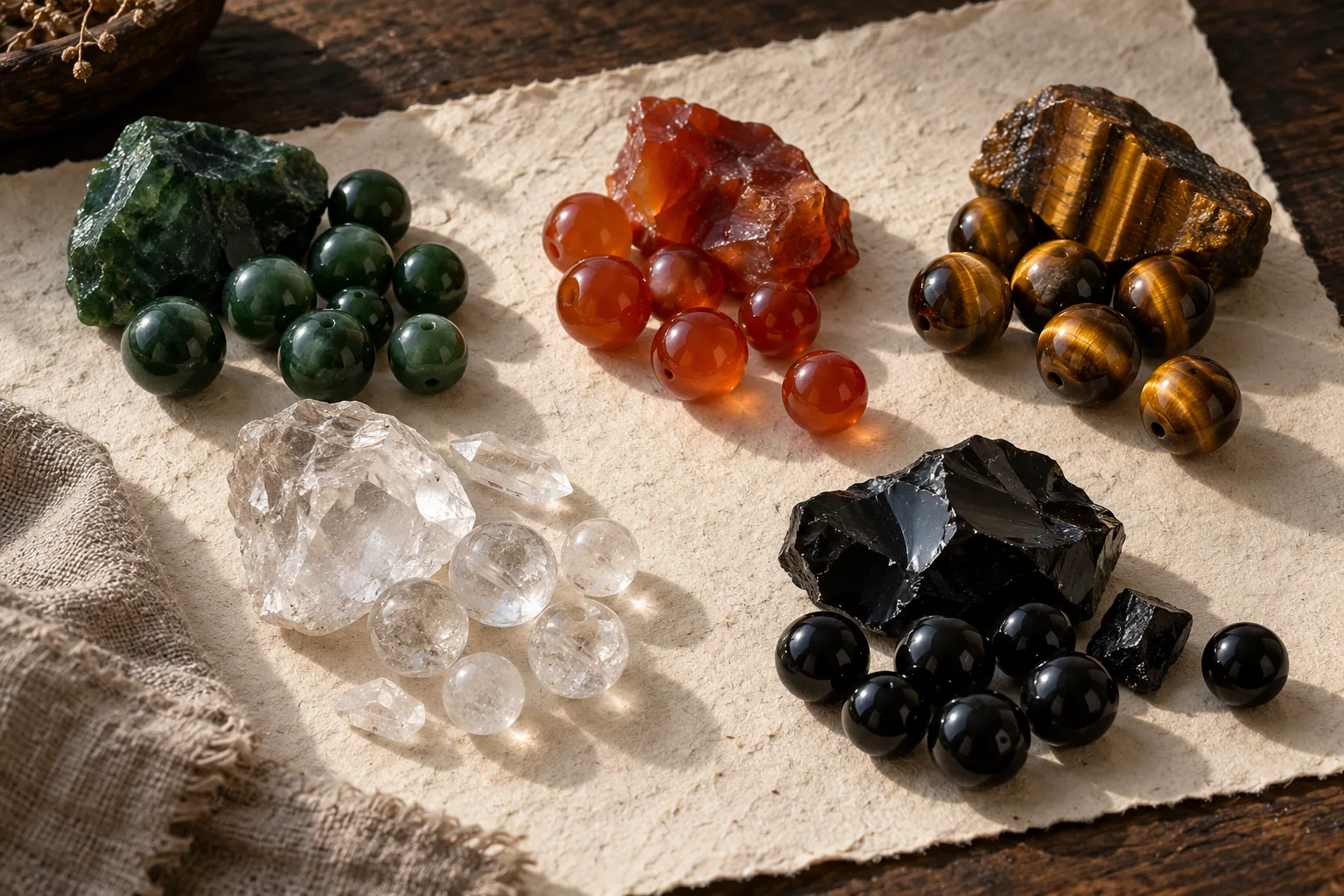
The elements describe relationships as well as objects
Wood, Fire, Earth, Metal and Water provide a traditional language of interrelated change. In spaces, they are often expressed through growth, activity, stability, refinement and flow. Colour is one expression; shape and material can also contribute.
A room with a wooden floor does not need green walls to contain a Wood image. An active, warmly lit area does not require a literal flame to suggest Fire. Seeing several relationships allows more flexibility than assigning each object a single fixed label.
Detailed colour associations vary among practices. The reference below helps explain common language rather than providing an automatic formula for every property.
Common associations to recognize
An object can carry several features at once. A white round ceramic piece has a colour and shape often used for Metal, while its material can be read through Earth. The method determines how these features are interpreted.
The generating and controlling cycles describe relationships rather than a ranking of favorite colours. A generating relationship is not an instruction to add unlimited quantities of one colour or object. Proportion and the whole room remain relevant.
- Wood: green and blue-green, or blue in some systems; upward forms, plants and wooden objects.
- Fire: red and strong warm tones; pointed forms, light and fire imagery.
- Earth: yellow, brown and earth tones; square or low forms, ceramic and stone.
- Metal: white, grey and metallic tones; round forms, curves and metal.
- Water: black and deep blue; waves, flowing lines and water imagery.
One sample changes across the day
Before choosing a wall colour, view a sample where it will be used in morning, afternoon and artificial light. A window-side wall and a shaded corner may look different. A screen image offers a starting point, while existing furniture and real light provide the final context.
Darker colour can gather attention into a zone, while brighter colour can create a focal point. Scale matters. A cushion, curtain, small artwork or movable object allows you to try a change before committing to a large surface.
Material alters the impression too. Glossy tile, matte paint and fabric may share a hue yet reflect light differently. Consider cleaning, touch, glare and how often the area is used alongside the elemental association.
Give colour a task within each room
A bedroom commonly benefits from a stable visual background and controllable light. A strong red can still appear in a small personal object. Whether it suits a whole wall depends on room scale, light and the occupants. Yin and yang cannot be reduced to all-dark or all-bright decoration.
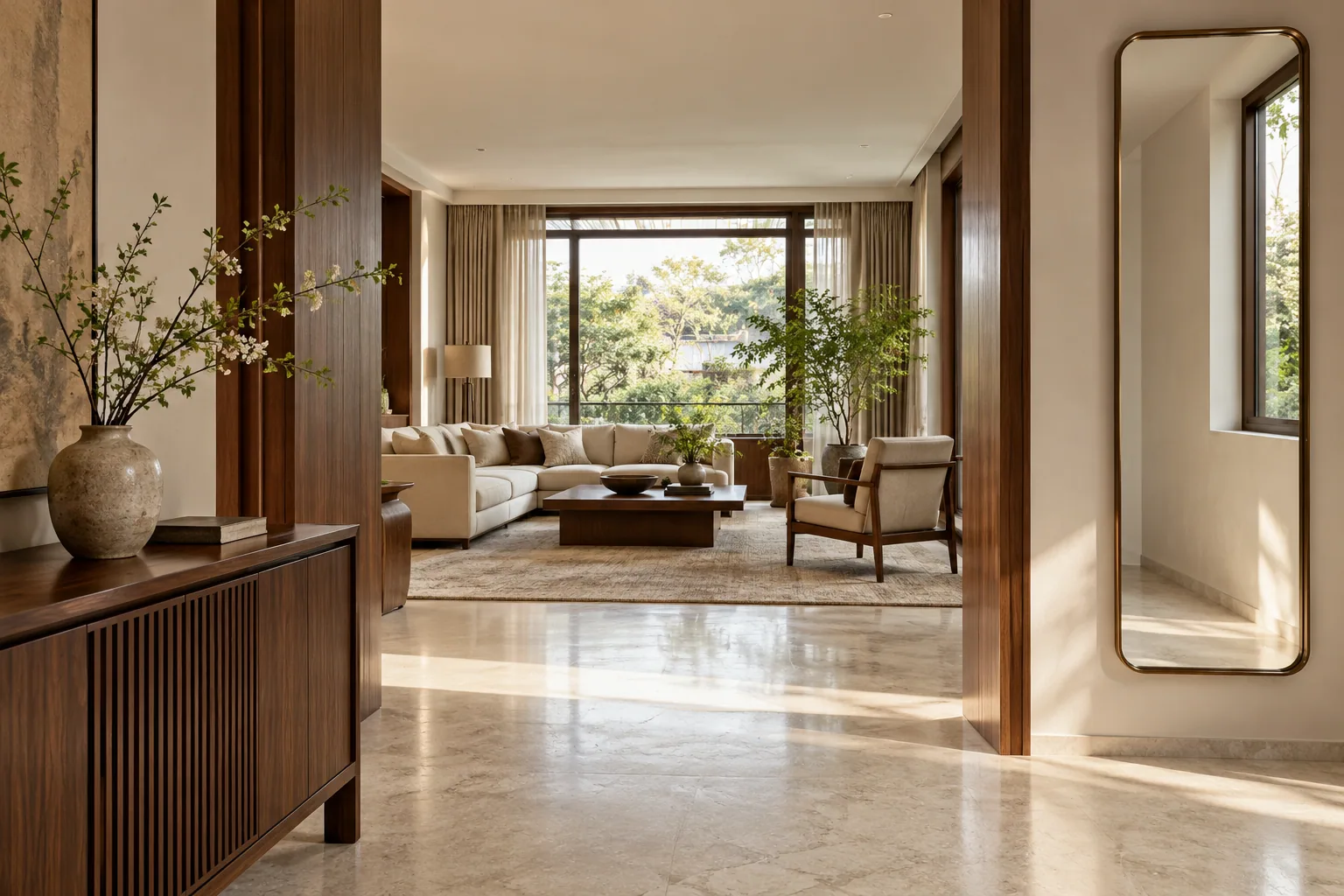
A work area can use colour to define a clear surface while avoiding distracting reflections around a screen. A living room can connect rug, seating and art into a gathering theme without painting every compass sector differently. Colour helps people read the space.
Kitchens and bathrooms already contain fixed materials and equipment. Their maintenance and lighting matter. A Wood image can appear through colour or artwork where a plant would not grow well; Water can be represented without installing a new fountain.
Room elements and personal favorable elements differ
Spatial Five Elements interpretation concerns rooms, directions, forms and materials. Favorable elements in BaZi come from a reading of birth information. Liking green, having much wooden furniture and having a particular chart distribution are different kinds of information.
An existing personal interpretation can inform a choice alongside shared family use, rental restrictions and the current interior. One person’s preference need not make every room the same colour. A frequently used corner, a personal object or a wearable composition offers another scale of expression.
Ready-made bracelets have their existing Five Elements themes; a personal composition is discussed through birth details and intentions. A room and a bracelet can echo one another without matching exactly.
Allow time to live with a small adjustment
Choose an existing corner and retain its function while changing one colour or material. Notice how it relates to the surroundings, whether the light feels appropriate and how easy it is to maintain. A change that is easy to reverse provides a useful comparison.
In a rental, textiles, lampshades, artwork and storage can offer options without repainting. A clear intention and a manageable change are more useful than treating wall area as a percentage calculation. The colour should work with the household’s ordinary life.
Questions & answers
Must each element occupy twenty percent?
No universal equal-share rule applies. The method, spatial relationships and actual functions matter more than dividing colours evenly.
Is blue associated with Wood or Water?
Deep blue commonly expresses Water, while some approaches use blue-green within Wood. Read the particular system and shade being described.
Does favorable Wood require a green bedroom?
No. A personal interpretation can be expressed on a smaller scale while respecting light, preferences and shared use.