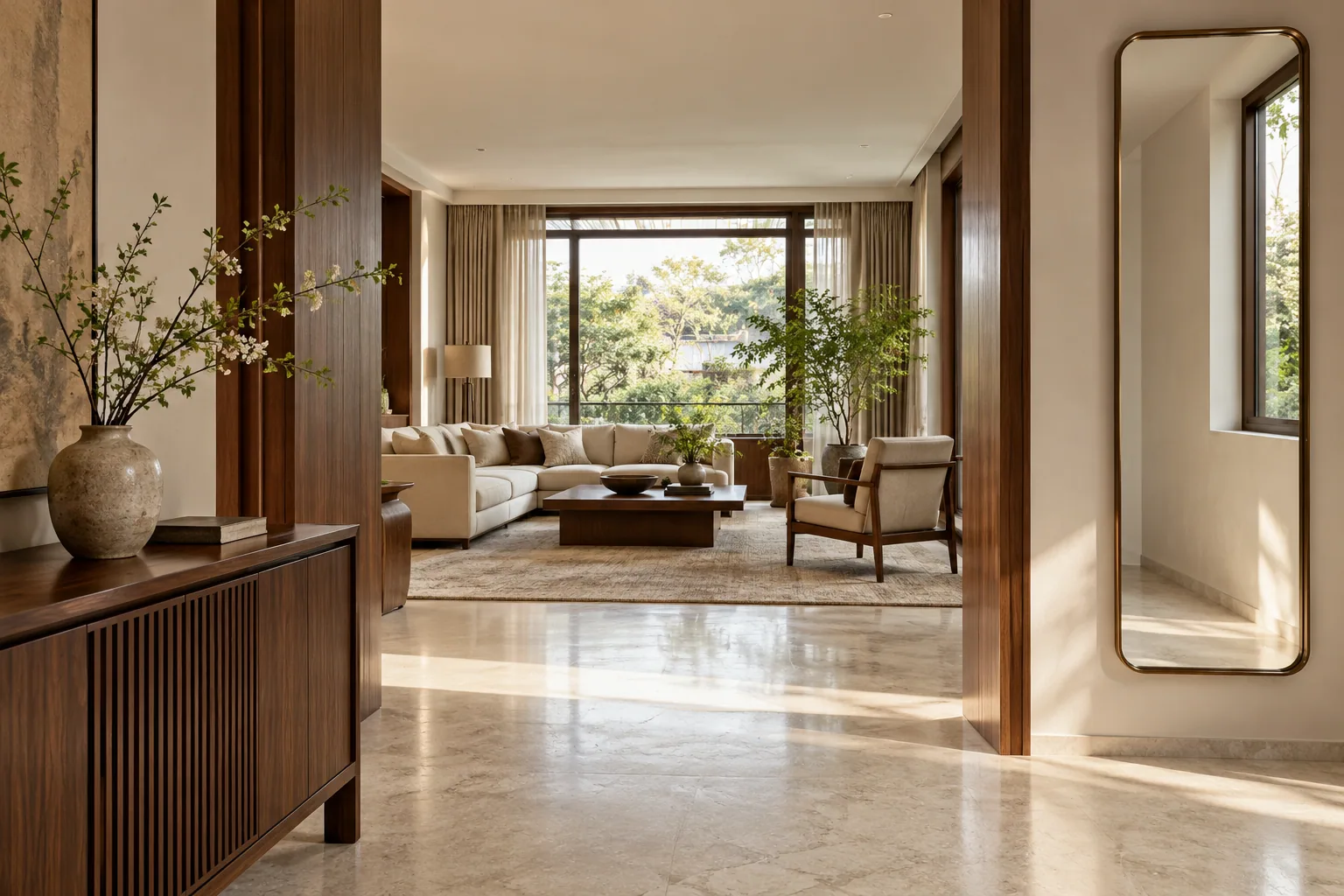
A relationship between people and their surroundings
Feng Shui developed within Chinese traditions of place, orientation and environmental interpretation. Qi, yin and yang, and the Five Elements provide its cultural language. They describe movement and feeling, contrasting qualities such as light and shade, and relationships between forms and changes.
In a modern home, these ideas can be considered through different functions. An entrance connects outside and inside. A living room accommodates company. A bedroom gives stillness a greater role, while a kitchen contains active work and heat. Every part of the home need not be equally bright or busy. A clear relationship between its uses gives the whole interior more coherence.
Building conditions also have their own practical requirements. Leaks, electrical faults, gas appliances and structural concerns need the appropriate physical attention. Traditional orientation and auspicious objects express a cultural approach to a place; they do not carry out repairs. Both belong in a considered home.
See the plan before adding another object
Sketch the room outlines, doors, windows, fixed cupboards and the furniture used most often. The drawing need not be professional. Show which way doors swing, where a chair sits when pulled out, and whether furniture covers a window. Then draw the routes people actually take: arriving with bags, getting out of bed, or moving between preparation space and the sink.

If several routes squeeze through one narrow point, changing furniture size or position is often more useful than adding decoration. A handsome shoe cabinet may stop the entrance opening fully. A display arranged in a supposed wealth corner may push everyone into the seating area. Keep a workable route and make later symbolic choices around it.
Include changes over the day. A spot with pleasant morning light may be glaring by afternoon. A route used at night needs to be considered with the lighting on. An empty-room photograph rarely reveals all of these relationships.
Why do two Feng Shui maps disagree?
Form-based approaches consider surrounding shapes and spatial relationships. Compass-based approaches use measured directions. Some contemporary entrance-aligned bagua methods position their map from the entry side. These are different reference systems, so a corner may receive different names.
Check whether a recommendation uses geographic direction or the entrance, and whether it concerns the whole dwelling, one room or a desk. A far-left corner on an entrance map is not automatically the southeast of a building. Flying-star analysis adds a time dimension and further property information.
The guides in this collection distinguish common methods from practical furniture choices. You can understand the map through the bagua guide and record direction through the facing guide. Meanwhile, observing furniture scale, room function and movement remains useful even before choosing a directional method.
Give each room its own task
In a bedroom, consider the bed, doorway, windows and access for each sleeper. At a desk, consider the view, movement behind the chair and screen glare. In a living room, arrange sitting and walking together. In a kitchen, preparation and storage need a workable sequence. These different tasks should not produce identical rooms.

Swipe to see the full comparison
| Space | Useful relationship to examine | Related guide |
|---|---|---|
| Entrance | Opening the door, shoes, bags and routes onward | Entrance and circulation |
| Bedroom | Headboard, door view and access | Bed placement and small rooms |
| Desk | Seat position, movement and daylight | Desk and office |
| Living room | Conversation and the main route | Living-room layout |
| Kitchen | Stove, sink, preparation and cupboard access | Kitchen layout |
Apartments, rentals and houses offer different choices
In a rental, fixed windows, doors and services may stay exactly where they are. Useful changes include the relationship between bed and desk, cupboard depth, lighting and everyday storage. If a small room allows one main route, keep it clear. A movable side table can be more useful than forcing a matching furniture set into the available space.
In an open-plan apartment, a rug, a lamp or lower furniture can suggest a zone without a tall divider. A house with a garden adds external relationships: road access, slope, drainage and the position of the entrance. The area being considered changes with the type of home.
Auspicious objects can follow a workable layout. Choose things whose meaning you appreciate and whose care fits your life. Plants need suitable light, fountains need maintenance, and fragile pieces need a stable place. Symbolism and practical use should support the same arrangement.
Make a change you can actually compare
Choose one recurring difficulty, such as bags behind a door, glare at a desk or a tight route beside the bed. Photograph the original arrangement, change one factor and use it for several days. Compare access, storage and the experience of sitting or moving. This gives you a clearer basis for keeping an adjustment.
For further home analysis, useful information includes a plan with doors and windows, a direction record, room photographs and the furniture you want to retain. Family habits matter too. A shared dining table or a child’s play area is part of the brief. The subject is a home with people in it, rather than an empty diagram.
Questions & answers
Does home Feng Shui require buying objects?
No. Furniture, views, movement and use provide many possible adjustments. An object can be chosen later for a meaning and maintenance routine you understand.
Can a rental be improved without moving large furniture?
Consider lighting, smaller storage, desktops, space behind doors and movable pieces while retaining fixed installations.
Is a north-facing home automatically unfavorable?
One direction alone cannot describe the whole property. The surroundings, layout, method and actual use all contribute to an assessment.