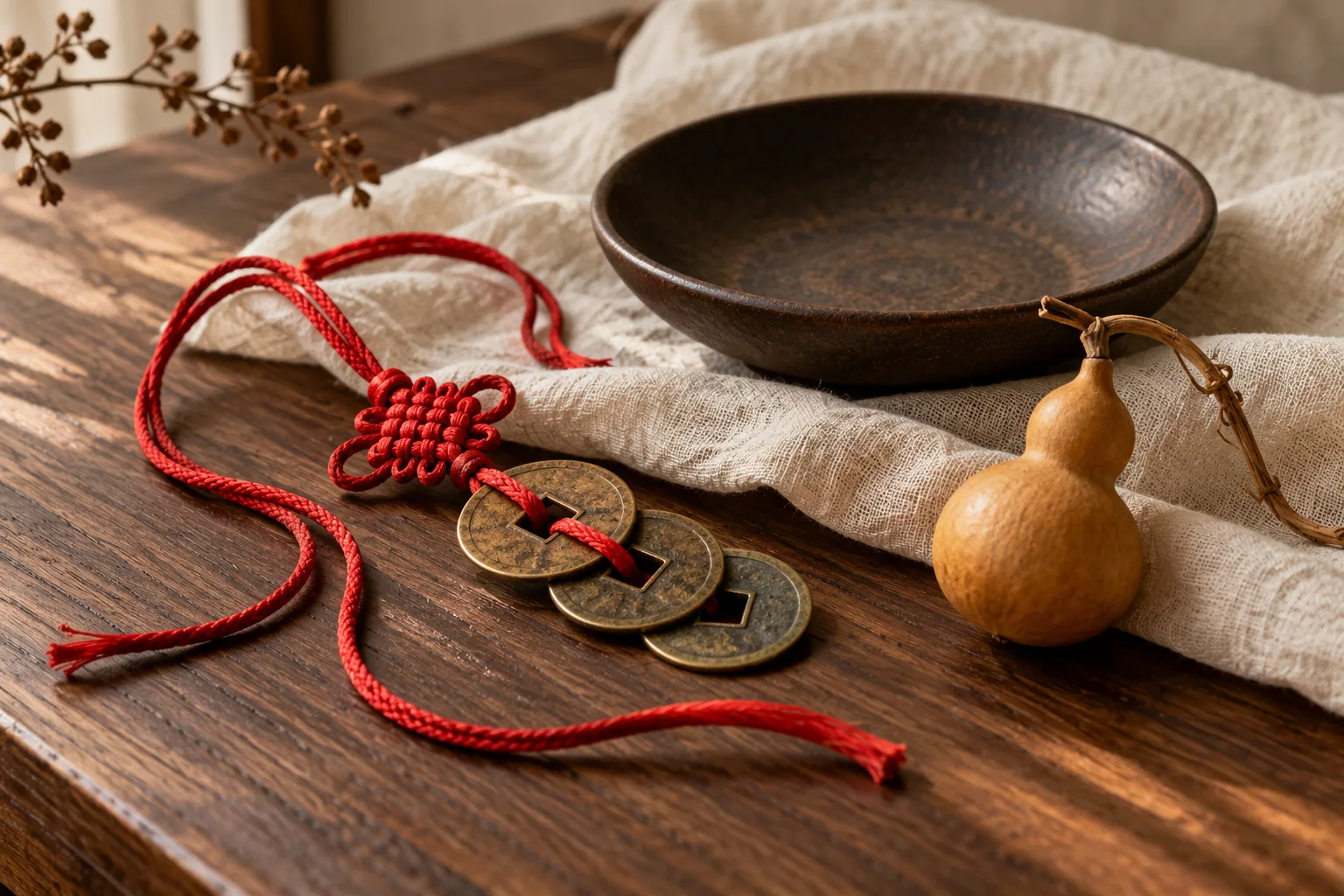
A particular practice rather than a requirement for every home
Some practices use a salt-water container within a particular star-sector interpretation, explaining it through elemental relationships. Common descriptions include salt, water and metal coins; some specify six coins. Counts, orientation and renewal belong with the source method.
Teachers differ on use, location and maintenance. Identify the year, diagram and kind of space addressed. A location in an old article cannot be detached from its date, and another household’s number of containers does not establish yours.
Cure here is a Feng Shui adjustment term rather than a medical treatment. It describes an interpretive practice. Actual leaks, damp, equipment or lighting still need their own attention.
Why salt appears around the rim
Water can evaporate from a salt solution while the dissolved material remains. Visible crystals may then form. Temperature, humidity, airflow, liquid level and container shape affect the appearance. University chemistry material explains evaporation as the removal of solvent leaving solute behind.
The amount of visible salt therefore first reflects material and environmental conditions. Crystal height is not a scale for measuring a household’s negative energy. Someone following the custom can keep its symbolic intention separate from the physical observation.
Deposits can develop around the rim and affect nearby surfaces through brine or moisture. A position that can be inspected and cleaned is easier to maintain than a completely hidden corner.
Choose a position that can actually be checked
Use a stable container suitable for its contents and a surface that can contain the arrangement. Glass, ceramic, metal and finishes have different properties. Keep brine away from vulnerable furniture and electrical equipment, and avoid a place repeatedly struck by a door or window.
Whether the top is open or partly screened, and how coins are arranged, belongs to the particular practice. Seeing the water level, moving the container steadily and keeping it out of accidental contact are practical questions for the actual home. Concealment should not mean forgetting it.
If the suggested area is a narrow bedside surface, equipment top or busy route, reconsider the physical placement. A Feng Shui method is being used within a room where people still live.
Observe the object without guessing at every change
Record the date, method and location to distinguish an annual arrangement from ordinary material behavior. Check the container, water, crystals, supporting surface and nearby objects. Photographs can help document those physical conditions.
Renewal depends on the chosen practice and the object’s condition rather than one interval for every climate. A dry heated room and a humid space can produce different evaporation patterns.
If the vessel is damaged, easily tipped or no longer manageable, end the display and handle the actual contents. Normal care does not need to wait for an omen. A home arrangement should still allow ordinary cleaning.
Treat the vessel and surrounding surface together
Make space to handle the container steadily, using appropriate support to prevent spills. Separate the coins, vessel and residue according to their actual materials and local handling requirements. Collectible coins are poor candidates for repeated brine exposure.
Clean the supporting surface after removal and inspect any residue. Decide whether continuing suits the room and household. Avoid disposing of salt water onto plants, common routes or a place that simply transfers the cleanup to someone else.
A particular tradition may have its own closing practice. That can be understood through its source while the material cleanup remains calm and orderly. The object need not become an unexplained burden that no one can touch.
Other adjustments may fit the home better
A household without a stable location, regular care or shared acceptance of an open container can choose not to use it. Furniture, light, circulation and storage are also part of spatial Feng Shui discussions.
If the concern is an annual sector, return to the correctly dated method and full property information. If the aim is a New Year wish for steadiness, a manageable object, a considered arrangement or a wearable composition offers other expressions. Understanding the basis is more useful than trying to make crystals grow faster.
Questions & answers
Do more crystals prove more negative energy was absorbed?
No measurement of household energy follows from crystal growth. Evaporation and environmental conditions affect the deposit.
Should every home use a salt-water container?
No. It is a practice used by some approaches, with its own context and maintenance requirements.
Can I follow a location from an old annual article?
Check its year and method. An earlier annual position is not automatically the current one.