 View larger
Larimar7–8 mm
Auspicious bracelets / Water
Larimar Bracelet · Enduring Scholarship
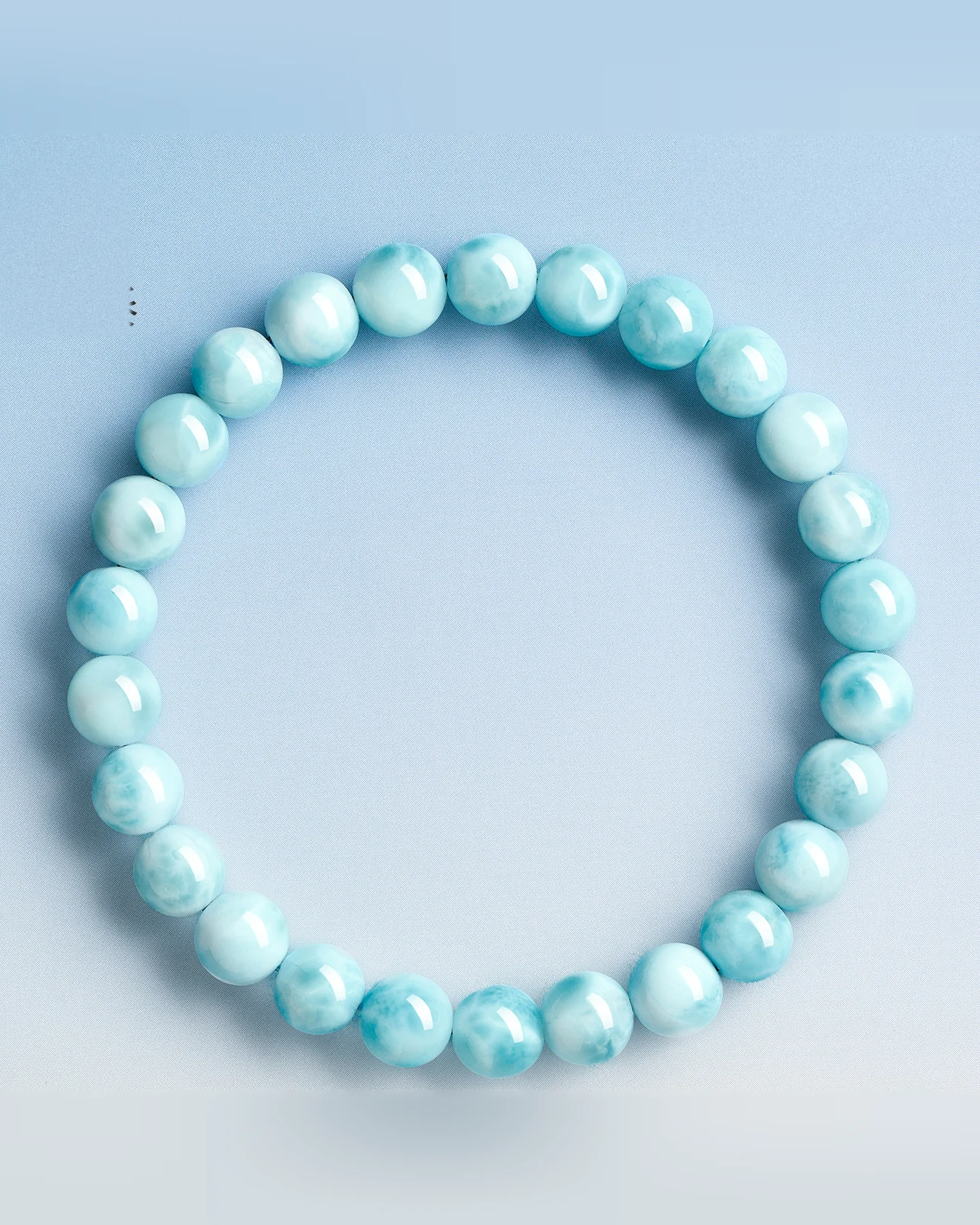
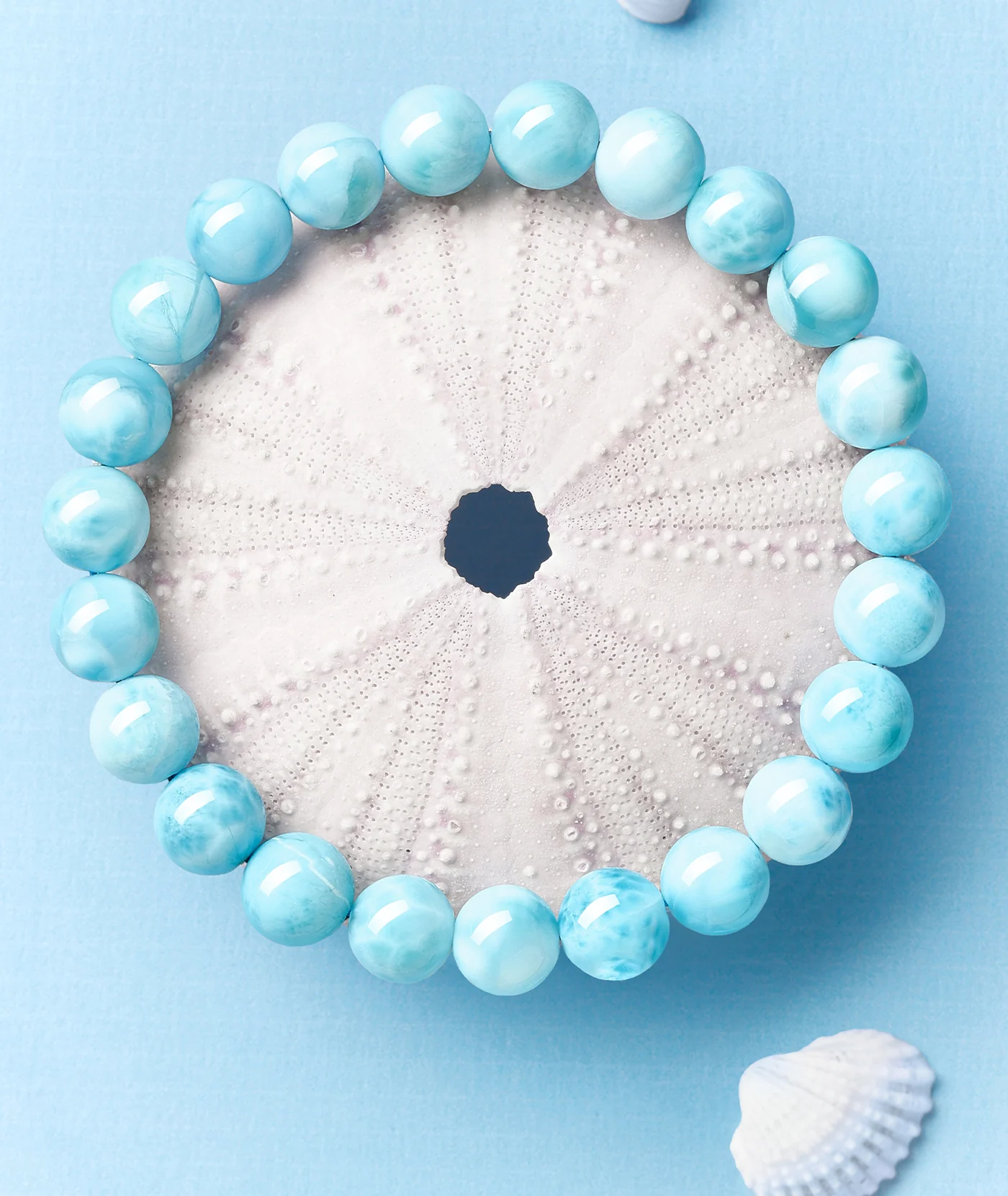
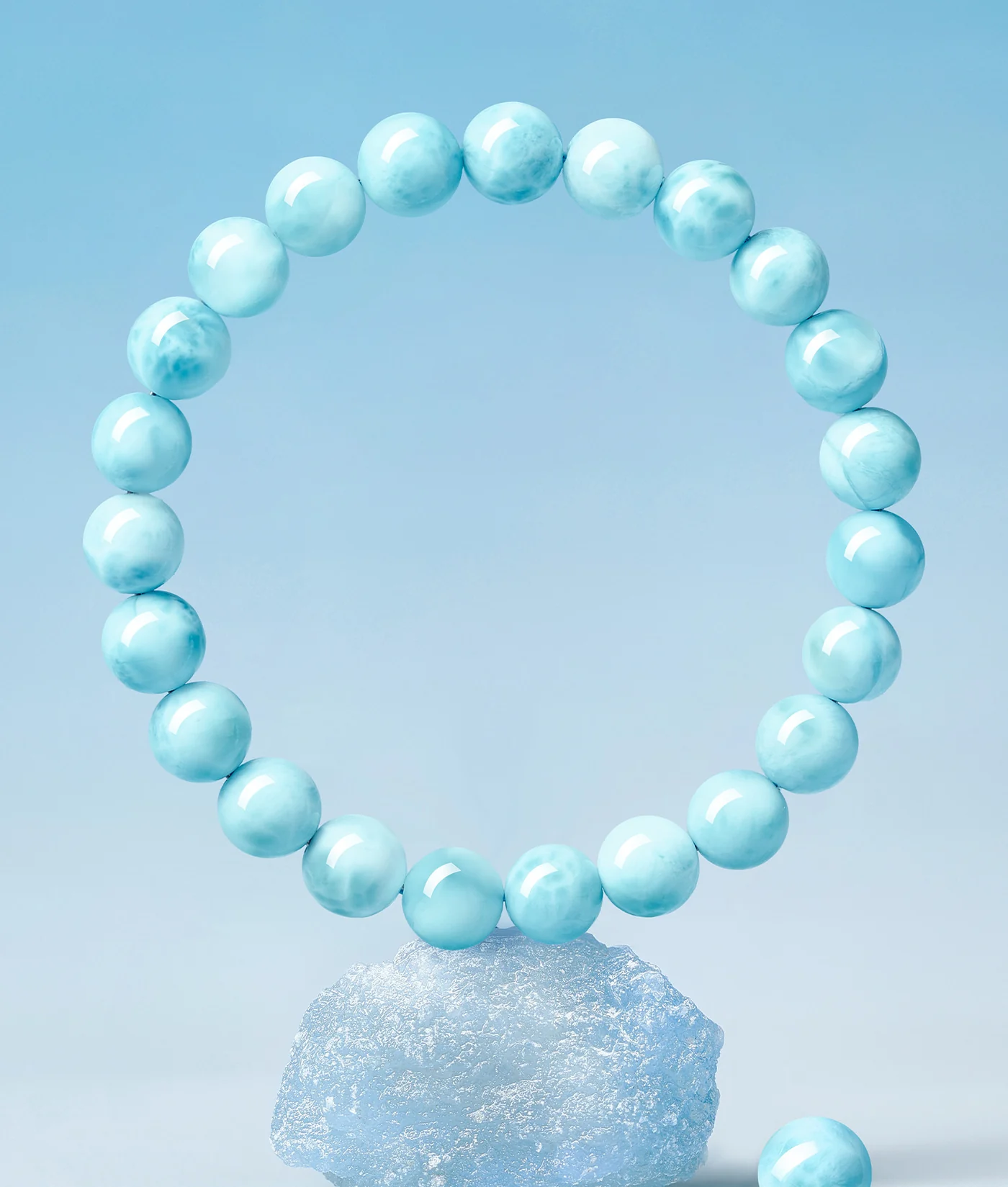
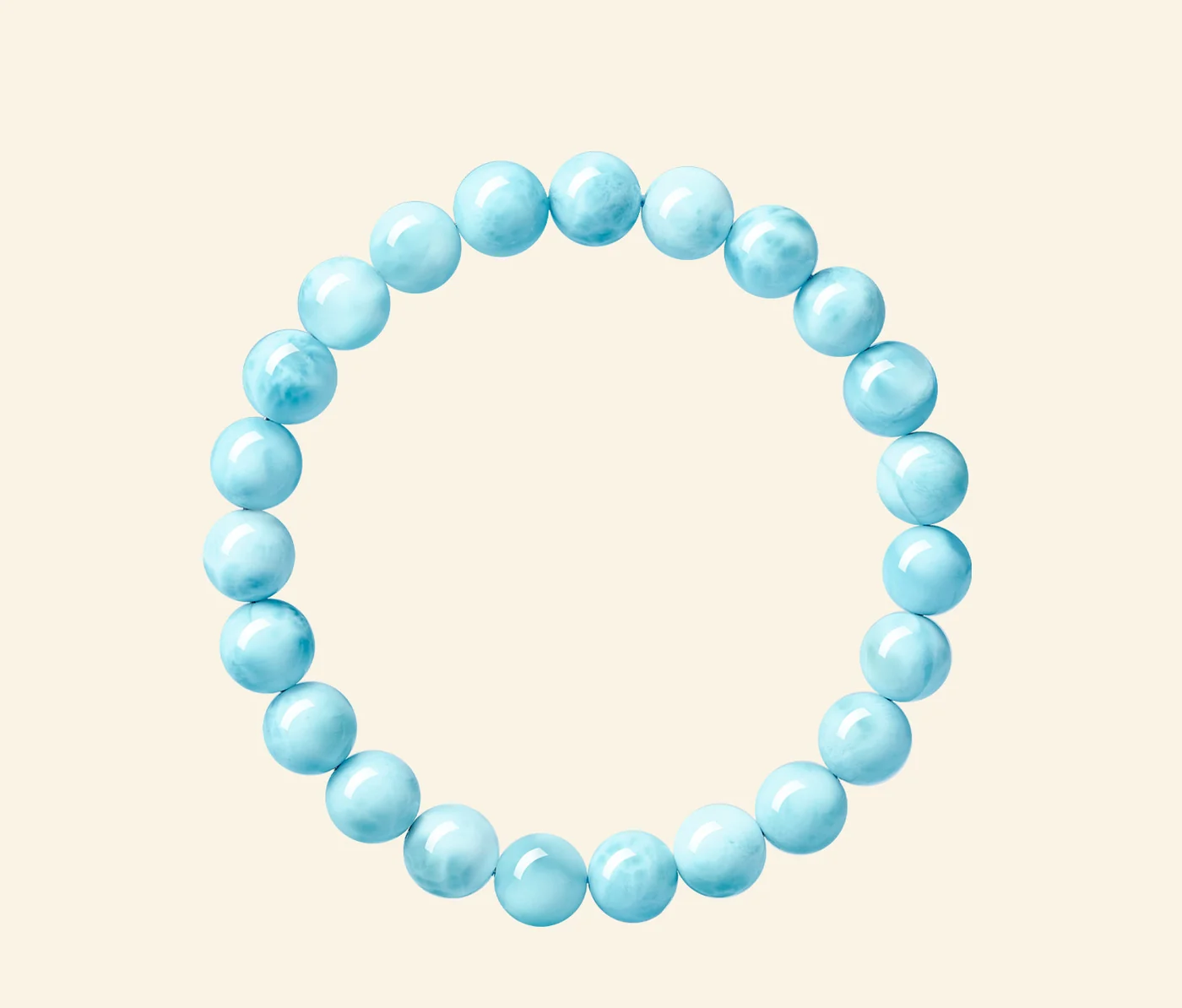
Sky-blue larimar of about 7–8 mm, each bead marked with white ripples like sunlight on shallow water.
$188.00USD
- Gemstones & materials
- Larimar (blue pectolite)
- Colour
- Sky to sea blue with white water-like patterns
- Bead size
- Approximately 7–8 mm
- Origin
- Dominican Republic, the only known source of larimar
- Cord
- Stranded elastic, single strand
- Style
- WX047
Prepared in 5 days after payment
Shipping: Asia $10; Europe, US, Canada, Australia & NZ $20
Ready-designed returns may be requested within 14 days. See returns policy
Enduring Scholarship
A spring of ideas, in sea blue
Enduring Scholarship is a strand of larimar, the sky-blue stone found only in the mountains of the Dominican Republic. Each bead is about 7 to 8 mm and carries its own pattern of white ripples and deeper blue patches, like sunlight moving over shallow water. No two beads are the same, and the strand looks calm from a distance and endlessly varied up close.
Its Chinese name, wen quan chang liu, means a spring of letters that flows on and on. It is a wish for a mind that keeps learning and a source of ideas that never runs dry, and blue belongs to Water, the element of wisdom.
- Larimar beads of approximately 7–8 mm.
- Sky blue with white, water-like patterns; every bead unique.
- Light, cool and comfortable for everyday wear.
- Wrist sizes from 14 to 21 cm, with the bead count adjusted to your size.
Enduring Scholarship
Enduring Scholarship in detail
What larimar is, where it comes from, how to judge its colour and pattern, and how to choose the right fit.
01
Larimar, the stone of one island
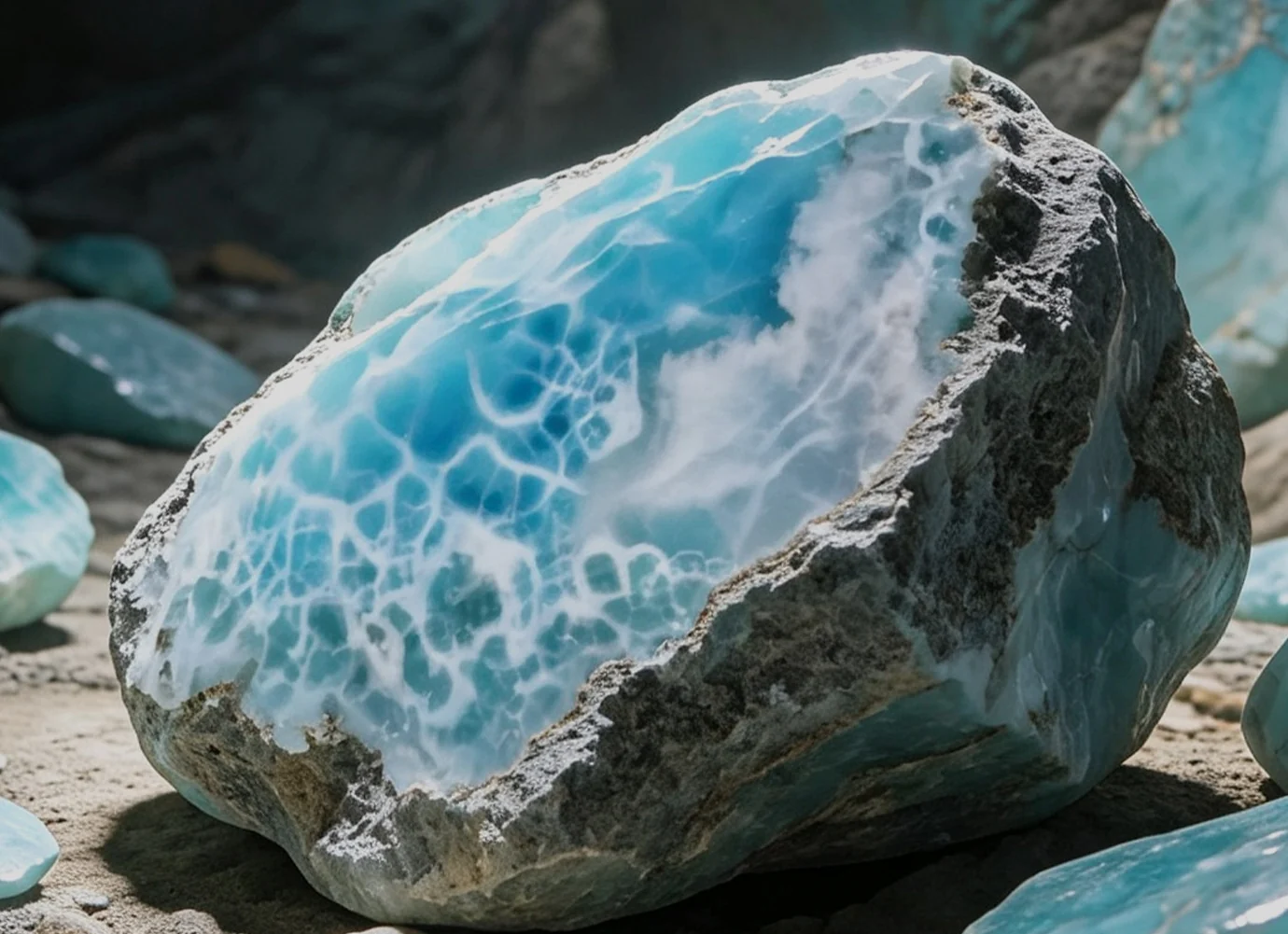
Larimar is a blue variety of pectolite, a calcium-sodium silicate that is usually white or grey. Its blue comes from small amounts of copper that replaced calcium as the mineral grew in cavities of volcanic rock. The only known commercial deposit is in the mountains of Barahona Province in the south-west of the Dominican Republic, which is why larimar is often described as the Caribbean in a stone.
The stone was known to local people for generations but became widely recognised only in the 1970s. Its trade name joins Larissa, the daughter of one of the men who promoted it, with mar, the Spanish word for sea.
02
Water patterns in every bead
Larimar grows in fibrous, radiating masses, and when it is cut and polished these fibres show as white streaks, ripples and net-like patterns across a blue ground. Many people compare them to light on the floor of a sunlit lagoon, or to the pattern a breeze leaves on water. The supplier describes the effect as blue and white interwoven, with waves formed by nature.
Patterns that look like a turtle’s shell, a fine net of white lines over blue, are especially prized by collectors.
03
Reading the colour
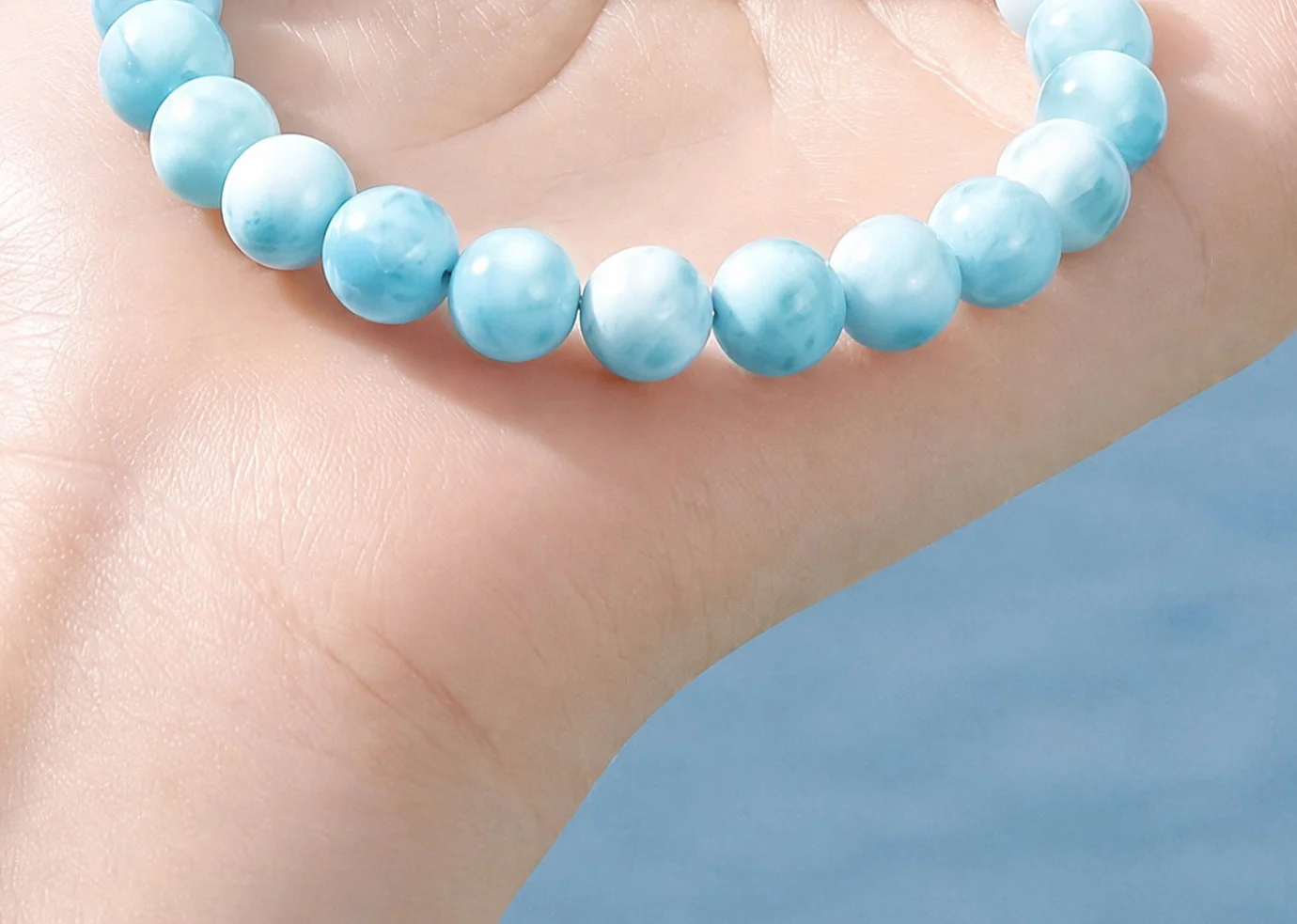
Larimar ranges from almost white with a hint of blue, through soft sky blue, to a deep volcanic blue. Green-tinted pieces also occur. Deeper, more saturated blue is generally rarer and more valuable, and the contrast between blue and white patterning adds to its beauty. The beads in this bracelet are a clear sky to sea blue with strong white patterning, chosen to look fresh and lively rather than uniformly dark.
04
What good larimar looks like
Good larimar beads combine an even, saturated blue with clear, well-defined patterning and a smooth, glossy polish. Lower grades are pale, greyish or blotchy, may have brown or red staining from iron, and are often dull because the fibres do not polish well. The supplier grades this bracelet as its highest quality, selected for colour, pattern and finish, and reports rejecting more than half of the beads it inspects.
| Feature | Lower grade | This bracelet |
|---|---|---|
| Colour | Pale, greyish or blotchy | Clear sky to sea blue |
| Pattern | Faint or muddy | Crisp white ripples |
| Staining | Brown or reddish spots | Clean to the eye |
| Polish | Dull or uneven | Smooth and glossy |
05
Why larimar is limited
Because larimar comes from a single small mining area, supply is limited. It is mined by hand in narrow shafts, and much of the material is pale, cracked or stained, so only a fraction is suitable for jewellery-quality beads. Clean, well-coloured rough large enough for round beads is scarcer still. This is one reason larimar has risen steadily in price and why imitations are common.
06
The mines of Barahona
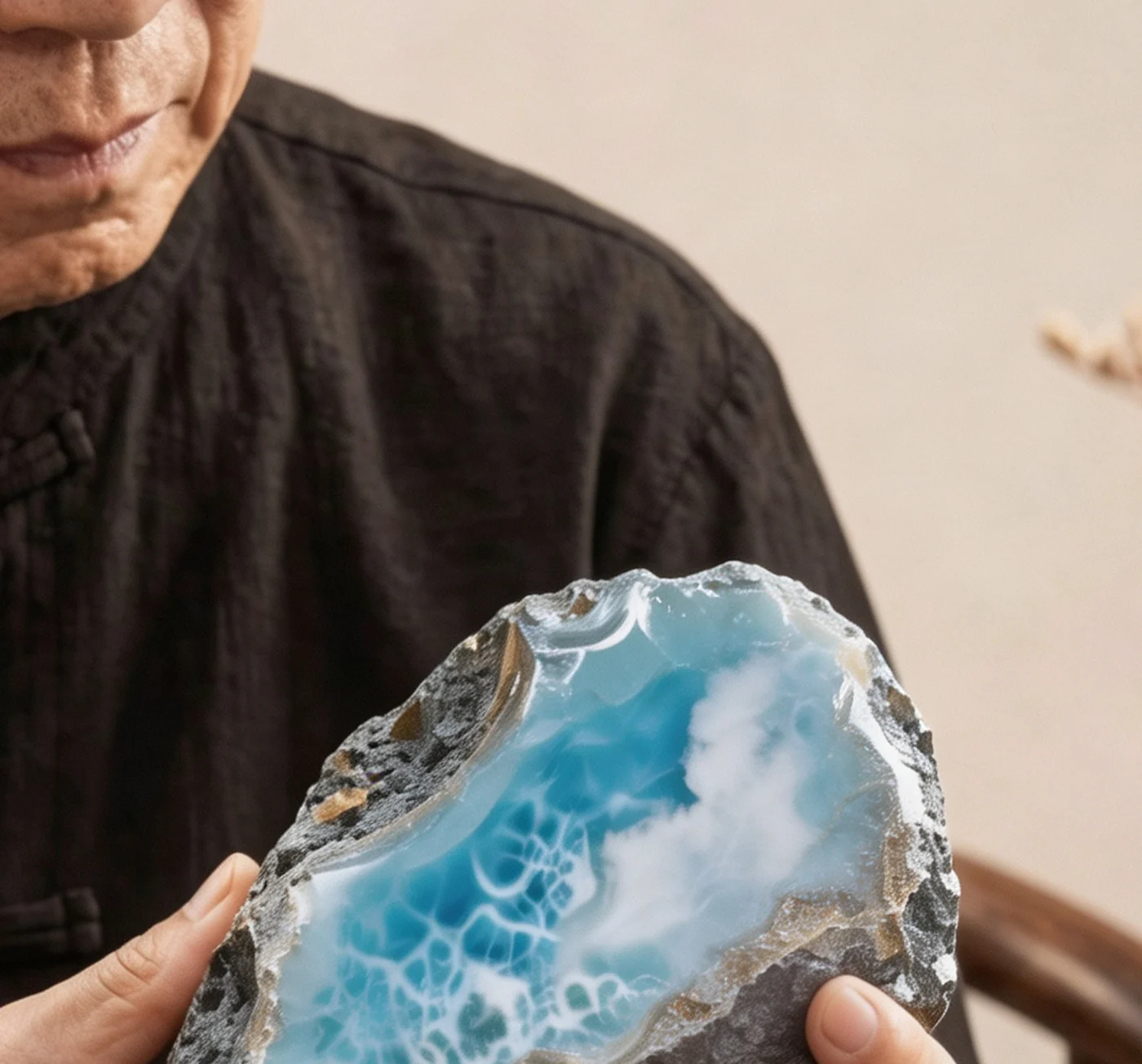
The larimar workings lie in steep, forested hills above the Caribbean coast near the village of Los Chupaderos. Miners dig narrow vertical shafts by hand, sometimes tens of metres deep, and bring the rough to the surface in buckets. The work is hard and seasonal, as heavy rain floods the shafts, and most of what comes out is pale or fractured. Much of the cutting and polishing is still done in small local workshops, and larimar is an important source of income in a region with few other industries.
Because the deposit is small and finite, many dealers expect fine larimar to become scarcer over time.
07
Choosing the rough
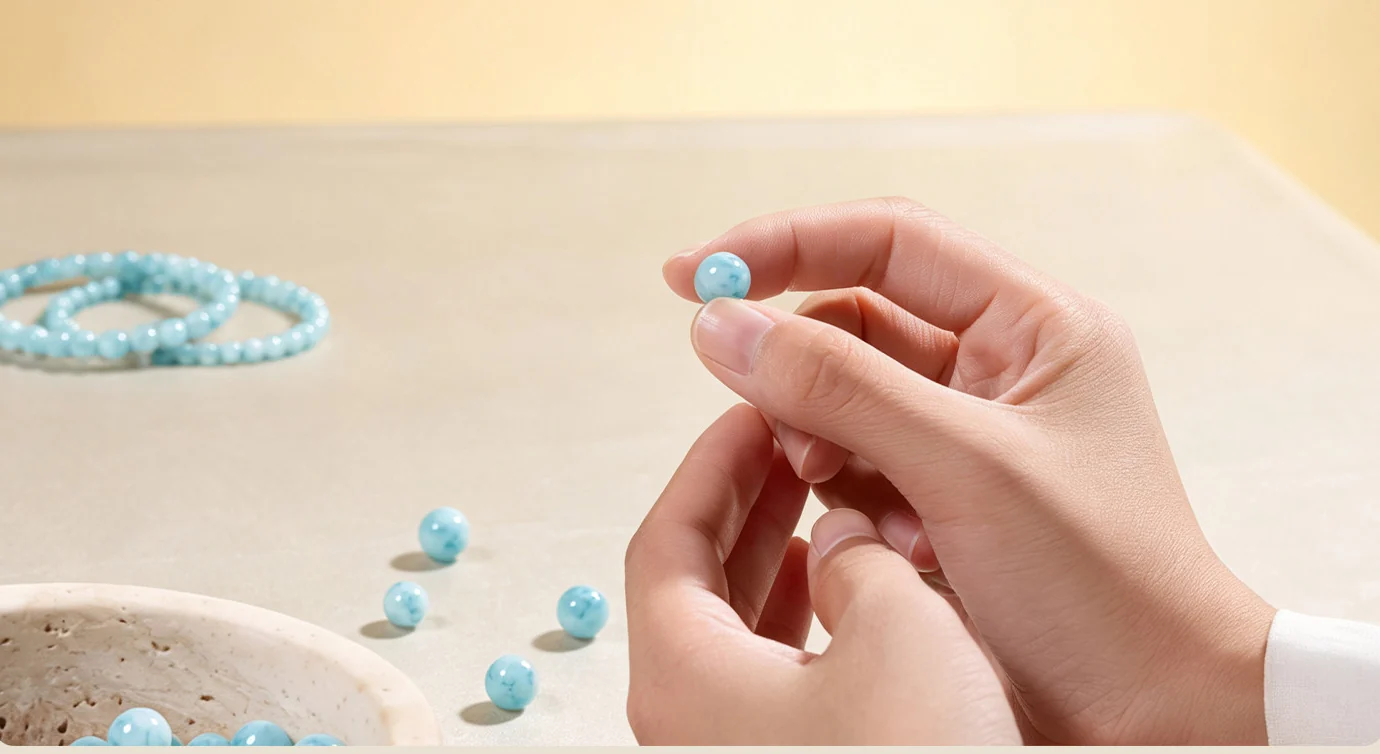
Experienced cutters study each piece of rough before cutting: where the blue is deepest, which way the fibres run, and where cracks or stains may hide. Beads are then laid out so that each one shows the best colour and a balanced pattern. The supplier describes this work as supervised by senior craftsmen, with every bead finished by hand.
08
Cut, polished and checked
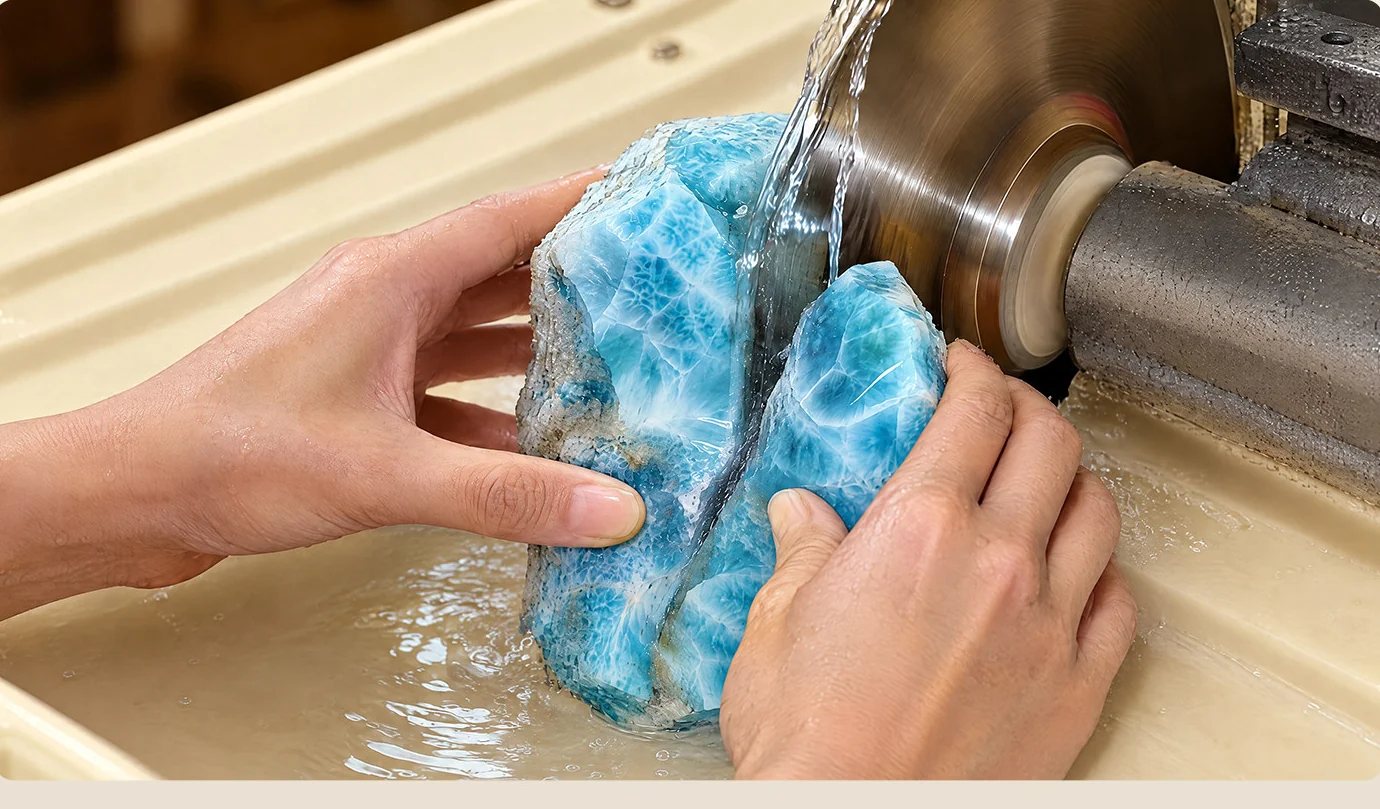
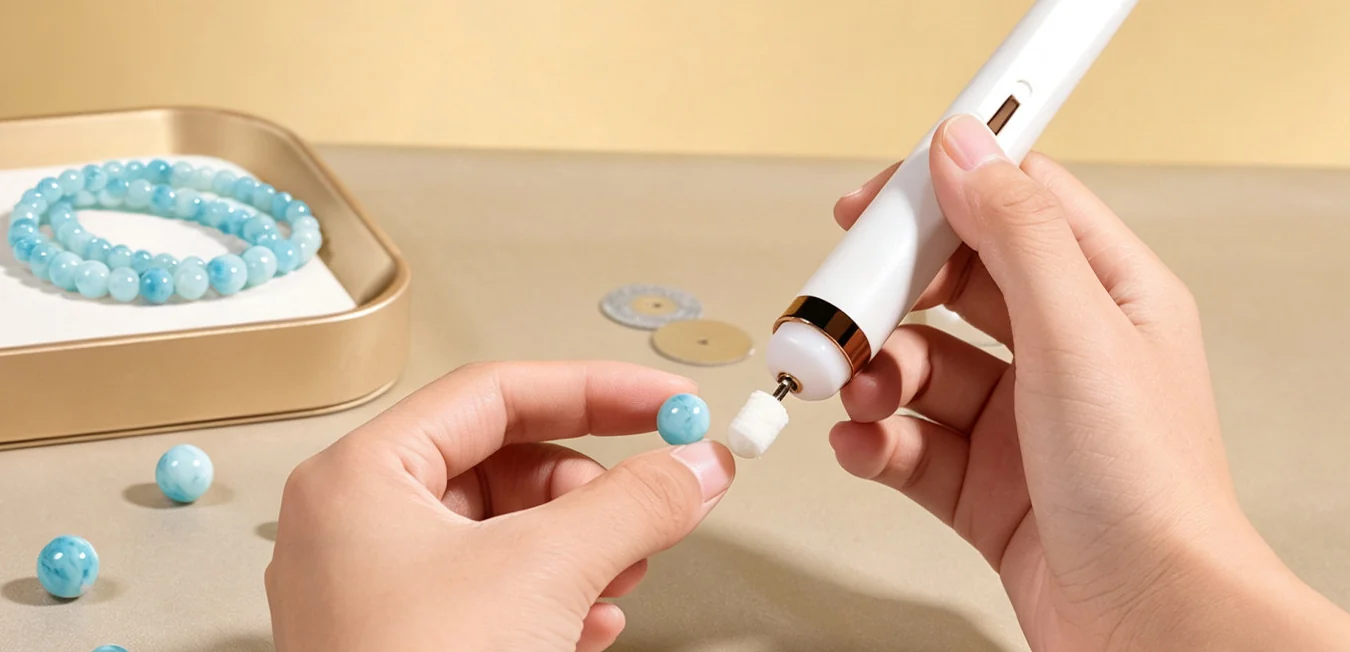
Selected rough is cut into blanks, rounded and then polished through several grades of abrasive until the surface takes a mirror-like shine. Larimar is softer than quartz, so the polishing must be gentle to avoid flattening the beads or pulling out fibres. Each bead is drilled with a smooth channel to protect the cord, then checked for colour, pattern and finish before it is strung.
Beads are matched along the strand so that colour and pattern are balanced rather than identical, which keeps the bracelet looking natural.
09
About the bead size
Larimar beads in this design are approximately 7 to 8 mm. The size is graceful on most wrists and large enough to show each bead’s pattern clearly. Larger larimar beads are available but rise steeply in price because big, clean rough is rare. As natural beads vary slightly, the exact count depends on your wrist measurement.
10
Choosing your wrist size
Measure the wrist itself with a soft tape or paper strip, just above the wrist bone where you usually wear a bracelet. Keep it snug without squeezing. For a close fit, choose that measurement; for an easier fit, add 0.5 to 1 cm.
The table gives approximate bead counts; each strand is checked against your measurement when it is strung.
11
A spring of letters
Wen quan chang liu borrows an old image: learning as a spring that keeps flowing. In Chinese writing, a scholar whose ideas and writing never run dry is said to have a spring of thought. The phrase wishes the wearer an open, curious mind and the steady discipline to keep learning year after year, through exams, research, writing and teaching.
Larimar’s rippling blue suits the image naturally: it looks like moving water caught in stone. These are cultural meanings and personal wishes rather than promises.
12
Blue and the Water element
In the Five Elements, blue and black belong to Water, the element of winter, the north and wisdom. Water is associated with learning, reflection and flexible thinking, and with communication. If you would like to know whether Water suits your own birth chart, a personal design begins with a fuller BaZi discussion.
13
A calm colour for long days
Many people choose larimar simply for its colour. Soft sea blue is restful to look at, and a glance at the wrist during a long day of reading or writing can feel like a brief view of open water. In modern crystal culture larimar is associated with calm, clear communication and gentle confidence, which suit the quiet work of study.
14
A companion at the desk
Some people like to make their bracelet part of a study routine: putting it on before opening a book or starting a writing session, and turning a bead between the fingers when a sentence will not come. The gesture is small, but it can mark the shift from distraction to focus, much as a scholar once ground ink before writing. Larimar’s smooth, cool beads are pleasant to touch and light enough not to get in the way of typing.
15
For men as well as women
Sea blue is a colour many men are comfortable wearing, and larimar’s white patterns give it a natural, rugged look rather than a polished jewellery shine. In larger wrist sizes the 7–8 mm beads sit as a quiet band beside a watch, and the bracelet suits casual shirts, linen and summer clothes especially well.
16
Recognising genuine larimar
Because larimar is valuable and limited, imitations are common: dyed howlite or magnesite, blue glass, resin, and reconstituted stone made from crushed larimar mixed with resin. Genuine larimar shows fibrous white patterns that look three-dimensional, slight variations in colour from bead to bead, and a cool, glossy surface. Imitations often have printed-looking or uniform patterns, dye concentrated in cracks, or a warm, plastic feel.
Our supplier describes these beads as natural larimar and provides a testing certificate. We confirm the material and documentation with the supplier before each strand ships; please contact us if you would like a copy.
17
Larimar and other blue stones
Larimar is sometimes confused with turquoise and blue chalcedony. Turquoise is a more opaque, often greener blue with brown or black matrix lines; aquamarine is a transparent pale blue beryl; blue chalcedony is translucent and evenly coloured. Larimar is distinguished by its white, fibrous water patterns across a blue ground.
18
Why this design changed
Enduring Scholarship was previously made with 15 mm oval labradorite beads in grey with flashes of blue. We now make it with larimar. The new design keeps the meaning of a continuing spring of ideas and brings it closer to the image of flowing water, with a fresher, brighter colour that suits everyday wear.
19
Wearing sea blue
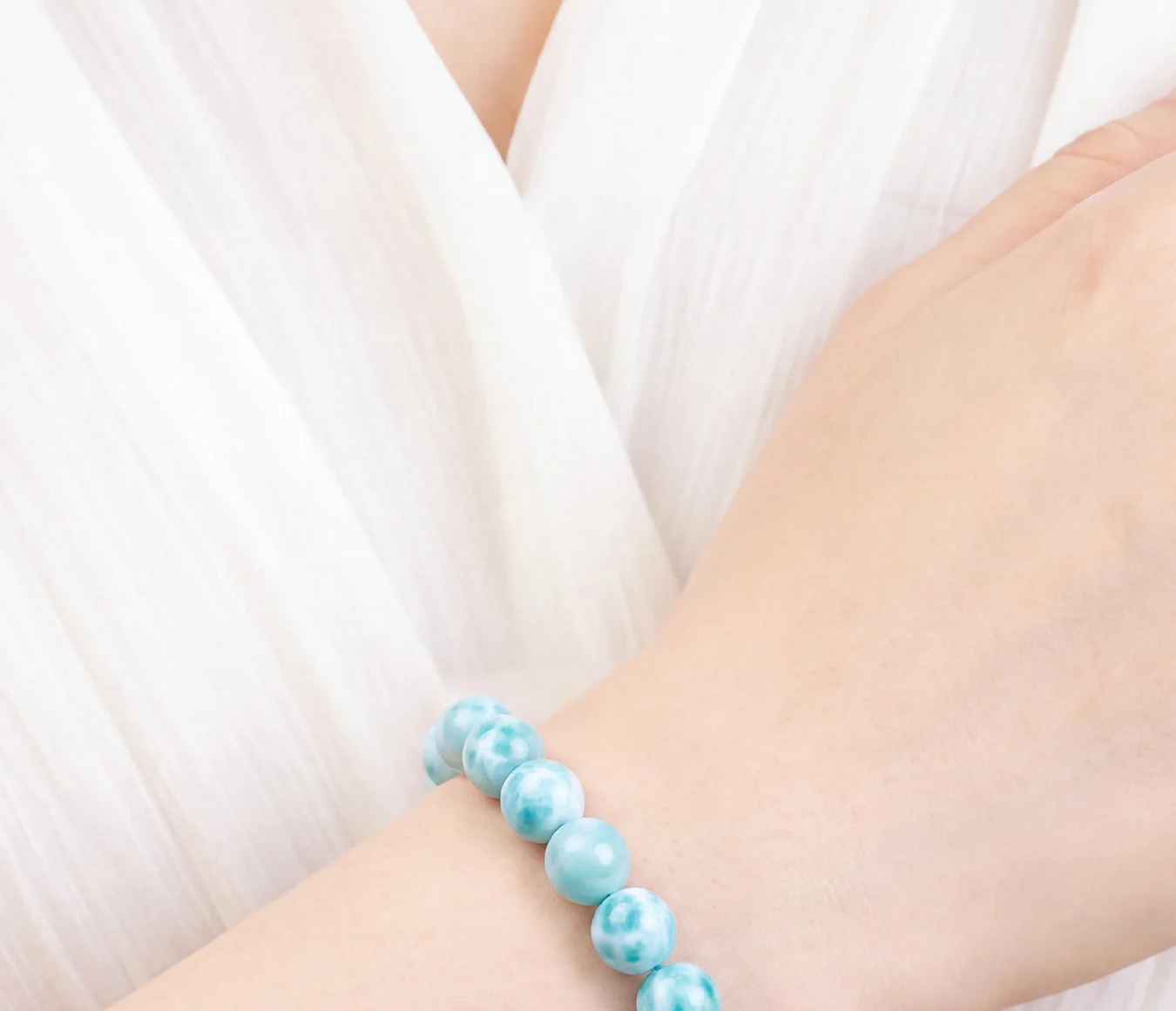
Larimar looks clean and fresh with white and cream, as the photographs show, and soft with linen, denim and pale grey. Against navy it glows; against summer tans it looks especially vivid. It pairs well with silver and white gold, and with a simple steel watch.
20
A bracelet for every season
Larimar is naturally associated with summer and the sea, but its cool blue is also welcome in winter, when it brightens dark knitwear and grey coats. Because it is light and comfortable, it suits long days at a desk, in a library or in a classroom. On holiday by the sea, it simply feels at home.
21
Pairing with other bracelets
Larimar pairs gracefully with a slim strand of clear quartz, moonstone or white agate for a light, airy look, or with aquamarine for a tonal blue stack. Keep harder stones from rubbing against it, since larimar is softer and can be scratched.
22
A gift for a learner
Enduring Scholarship is a thoughtful gift for a graduation, a new course of study, a teacher’s retirement or the start of a writing project. It also suits anyone who loves the sea and wants a reminder of open water in daily life.
A short note explaining wen quan chang liu makes the meaning clear. If you cannot measure the recipient’s wrist, choose the most likely size; an unworn ready-designed bracelet can be returned within 14 days of delivery.
23
Larimar and sunlight
Larimar’s colour can fade with long exposure to strong sunlight and heat. Normal wear outdoors is fine, but do not leave the bracelet on a sunny windowsill, on a car dashboard or near a heater. Stored in a drawer or pouch, its colour stays stable for many years.
24
Caring for larimar
At about 4.5 to 5 on the Mohs scale, larimar is softer than quartz. Remove it for sport, cleaning, swimming and bathing, and keep it away from perfume, lotion and household chemicals, which can dull the polish. Wipe it with a soft, slightly damp cloth and let it dry naturally.
Store it on its own in a soft pouch. Check the elastic every few months; with daily wear it usually lasts one to two years, and it should be replaced before it weakens.
Questions & answers
What size are the beads?
Approximately 7 to 8 mm.
What is larimar?
A blue variety of the mineral pectolite, coloured by copper.
Where does it come from?
The Dominican Republic, the only known source.
Is it natural?
Our supplier describes the beads as natural larimar and provides a testing certificate, which we confirm before shipping.
Are the beads all the same?
No. Every bead has its own pattern and shade of blue.
Will the colour fade?
It can fade with long exposure to strong sunlight; keep it out of direct sun.
Is larimar soft?
It is softer than quartz, so avoid knocks and abrasive surfaces.
Can it get wet?
Brief contact is fine; remove it for swimming and bathing.
Why did the design change from labradorite?
Larimar’s flowing blue fits the image of a spring of ideas more closely.
Which element is it?
Blue larimar is associated with Water.
How many beads will it have?
Roughly 22 for a 14 cm wrist and about 31 for 21 cm.
How is it different from turquoise?
Larimar shows white water-like patterns; turquoise is more opaque with darker matrix lines.
Is it suitable for men?
Yes, especially in larger wrist sizes or paired with a steel watch.
Can I wear it every day?
Yes, with care to keep it out of strong sun and away from chemicals.
How should I store it?
In a soft pouch, away from harder stones and direct sunlight.
Will it look exactly like the photographs?
The colour and pattern are natural, so your beads will vary slightly from those shown.
Why is larimar more expensive than other blue stones?
It comes from a single small deposit, and only a fraction of the rough is clean and well coloured enough for round beads.
What is the most prized pattern?
A fine white net over deep blue, often compared to a turtle’s shell.
Can I order larger beads?
Larger larimar beads are available at a higher price; ask an adviser.
Can I wear it with turquoise or aquamarine?
Yes. Keep the stones loosely stacked so harder beads do not rub the larimar.
Compare these related designs
 Personal designs
Career · Prosperity
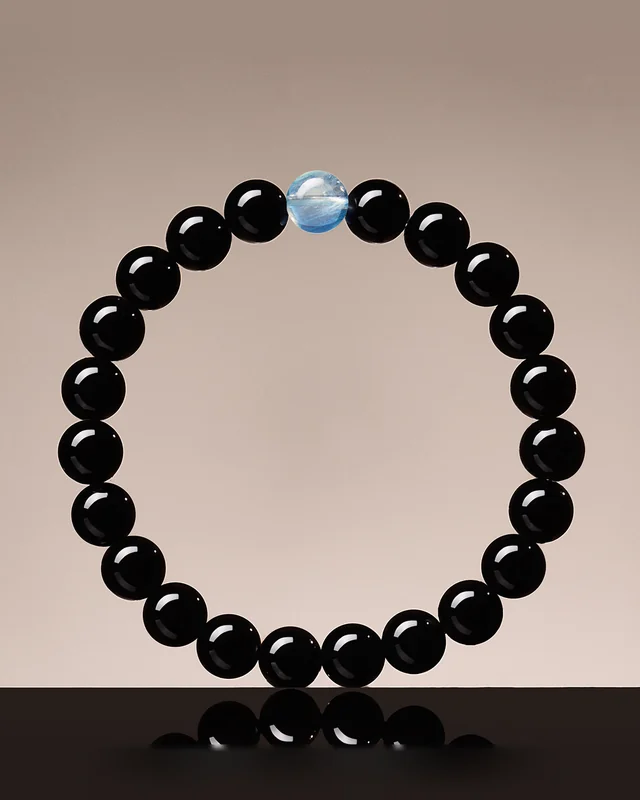
Custom Obsidian and Aquamarine Bracelet · Water Opportunity
Black obsidian · Aquamarine
Quoted after we confirm your design8 mm · Water