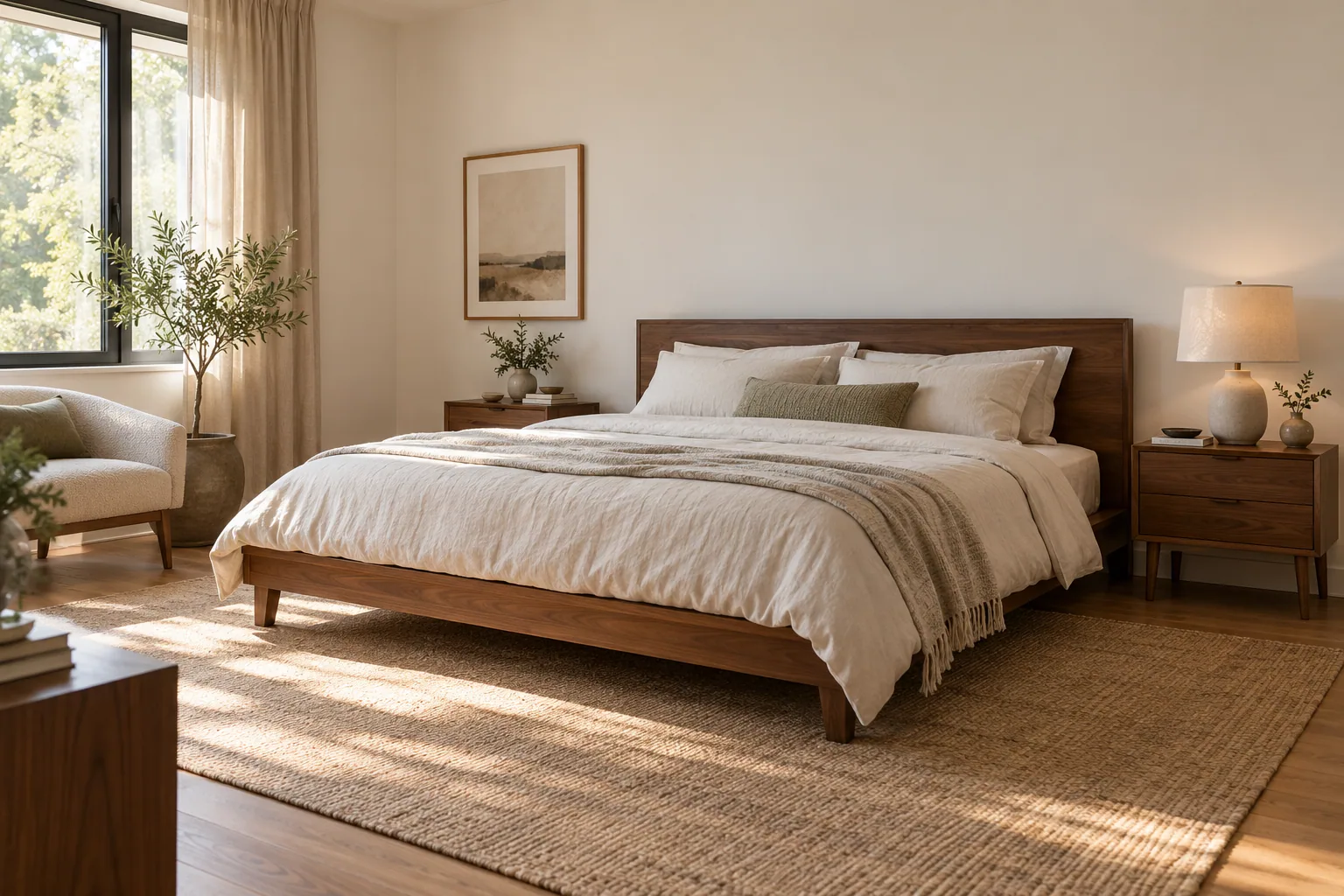
Seeing the door is different from lying directly in its path
The commanding position is commonly described as a view of the entrance, support behind the headboard and a bed outside the door’s direct line. This does not require placing a bed diagonally in the middle of the room or automatically choosing the most distant corner.
Sit where the pillows normally are. Does the doorway enter your view naturally? Compare the door half open and fully open. A distant position that requires turning your head, or one that looks straight into a brightly lit corridor, still has details worth considering.
Draw the main route entering the room. In one arrangement it passes beside the bed; in another, movement and the view from the door continue along the bed’s length. A small sideways move or a different headboard wall may change that relationship without adding a large screen.
Support includes the wall and window that are really there
A continuous wall gives a headboard a clear boundary. Also consider what is behind the wall, where sockets and lamps sit, and whether there is noticeable damp or noise. A headboard should be stable, with any decoration above it positioned appropriately. A sense of support benefits from practical conditions that can be maintained.
If the bed fits only beneath a window, compare the headboard height, opening mechanism, curtains and ventilation. The headboard should leave necessary window operation accessible. In a narrow room, a stable bed beneath a usable window may work better than forcing it against a cupboard. This is a layout choice rather than one verdict on every window-backed bed.
Where the available wall adjoins a bathroom, examine actual pipe noise, moisture and wall condition. Those observable issues have practical remedies. Directional interpretation is a separate layer of information.
A shared bed needs access that both people can use
Space on both sides supports getting in and out, making the bed and having a usable place for personal items. Matching furniture is only one way to express balance. If one side is narrower, a slim table or wall shelf may serve better than squeezing in two large identical cabinets.
Usable space includes open drawers, wardrobe doors and turning at night. Check the arrangement with bedding in place and a chair pulled out. A person who needs more room to move should not lose it for the sake of photographic symmetry.
A single bed against a side wall is common in a small room. Keeping its open side and foot route clear can still make a settled sleeping zone. Shared accommodation, a child’s room and a double bedroom have different users; the number of bedside tables alone does not describe their quality.
Compare complete arrangements
Imagine two options in a narrow room. One gives an easy door view but leaves the wardrobe half blocked. The other is closer to the entrance yet allows the storage and window to function. Try a smaller side table before rejecting the first option. If it remains obstructed, keep the more usable arrangement and improve its lighting or view.
Paper furniture shapes on a plan make these comparisons easier. Include the door swing and cupboard opening before moving heavy pieces.
Swipe to see the full comparison
| Existing condition | Arrangement to compare | Keep usable |
|---|---|---|
| Corner door and clear long wall | Headboard on the long wall, bed outside the direct door route | Continuous access to wardrobe |
| Door opposite window in a narrow room | Compare the two side walls | Window and wardrobe opening |
| Only the window wall accommodates the bed | Stable headboard and suitable curtains | Window operation and ventilation |
| One side must be against a wall | Clear outer-side and foot route | The only access path |
Test reflections from the bed, especially at night
A mirror cannot be assessed only from the doorway. From the pillow position, notice reflected corridor lights, passing headlights or a view you dislike. A movable dressing mirror can turn toward a wardrobe or side wall; a fixed mirror may be managed through its existing door or an appropriate covering.
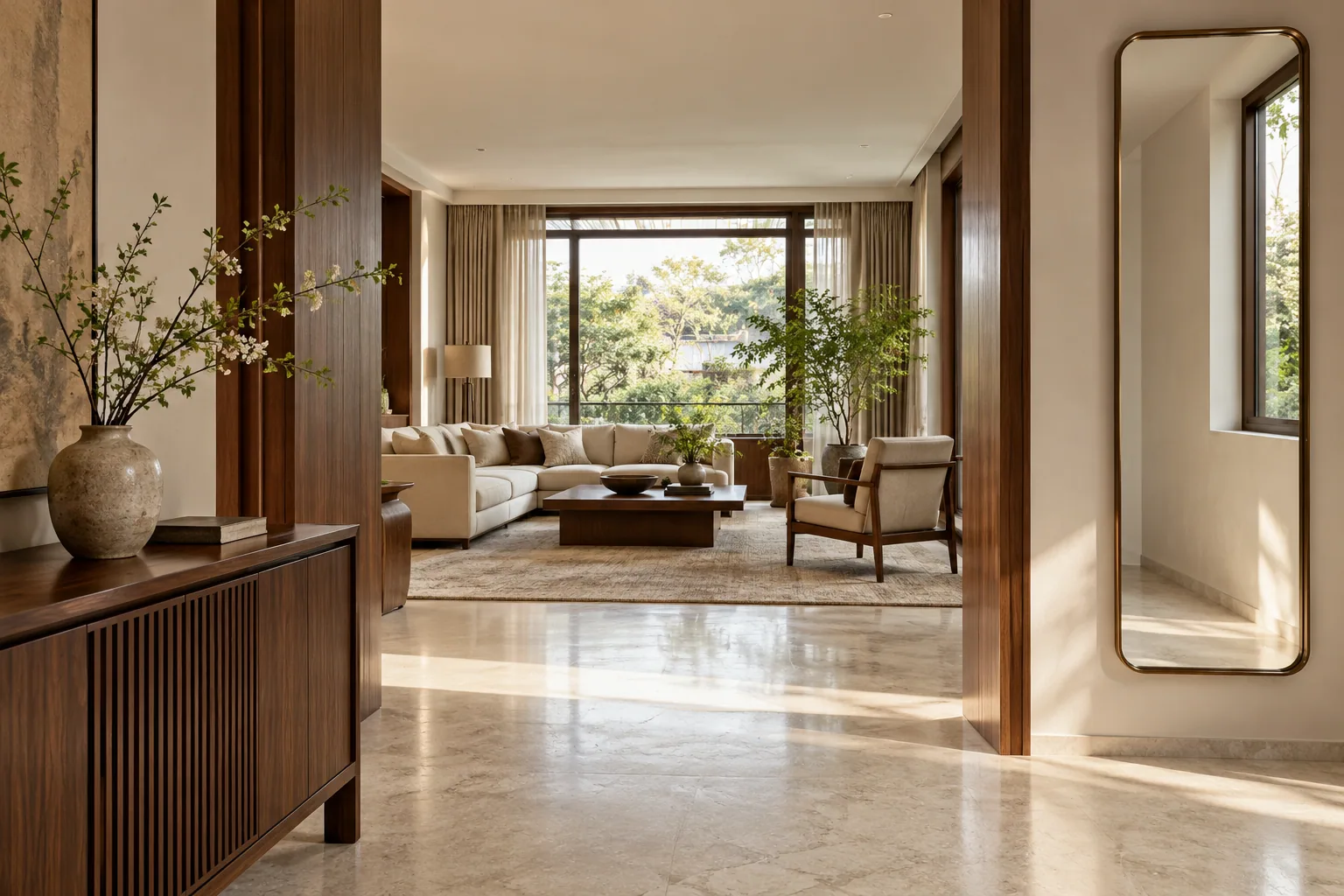
Some Feng Shui approaches use a mirror to improve an entrance view, while others prefer fewer reflections in the sleeping area. Their conditions differ. For the actual room, examine what is reflected, how securely the mirror is fixed and how the occupants experience it.
Reading light and a route used at night have different tasks. A bright daytime room can leave a dark path at the foot of the bed after sunset. A suitably positioned light may resolve that more effectively than additional decoration.
Give the resting area a clear identity
If storage under the bed is necessary, organize less frequently used items and retain access for cleaning. Where work and clothes share the bedroom, a closed cupboard or a cleared desktop can mark the end of the day. Small homes may combine functions while still giving them understandable boundaries.
Use the revised arrangement for several days. Notice opening the door, getting up, making the bed and reaching the curtains. If further directional analysis is wanted, record the headboard direction together with the plan. An angle alone cannot describe the complete room. Wishes for a settled home and harmonious relationships deserve a space its occupants can actually enjoy.
Questions & answers
Must a bed be diagonal to be in command?
No. Many rectangular rooms allow a supported headboard and an entrance view with the bed outside the direct doorway line. A diagonal bed may waste useful space.
What if the foot of the bed faces the door?
Compare a small sideways move, another headboard wall or smaller adjacent furniture while preserving access and door opening. Consider the whole room.
Do both bedside tables have to match?
Usable space matters more than identical furniture. Slim tables, shelves or different widths can serve two people well.