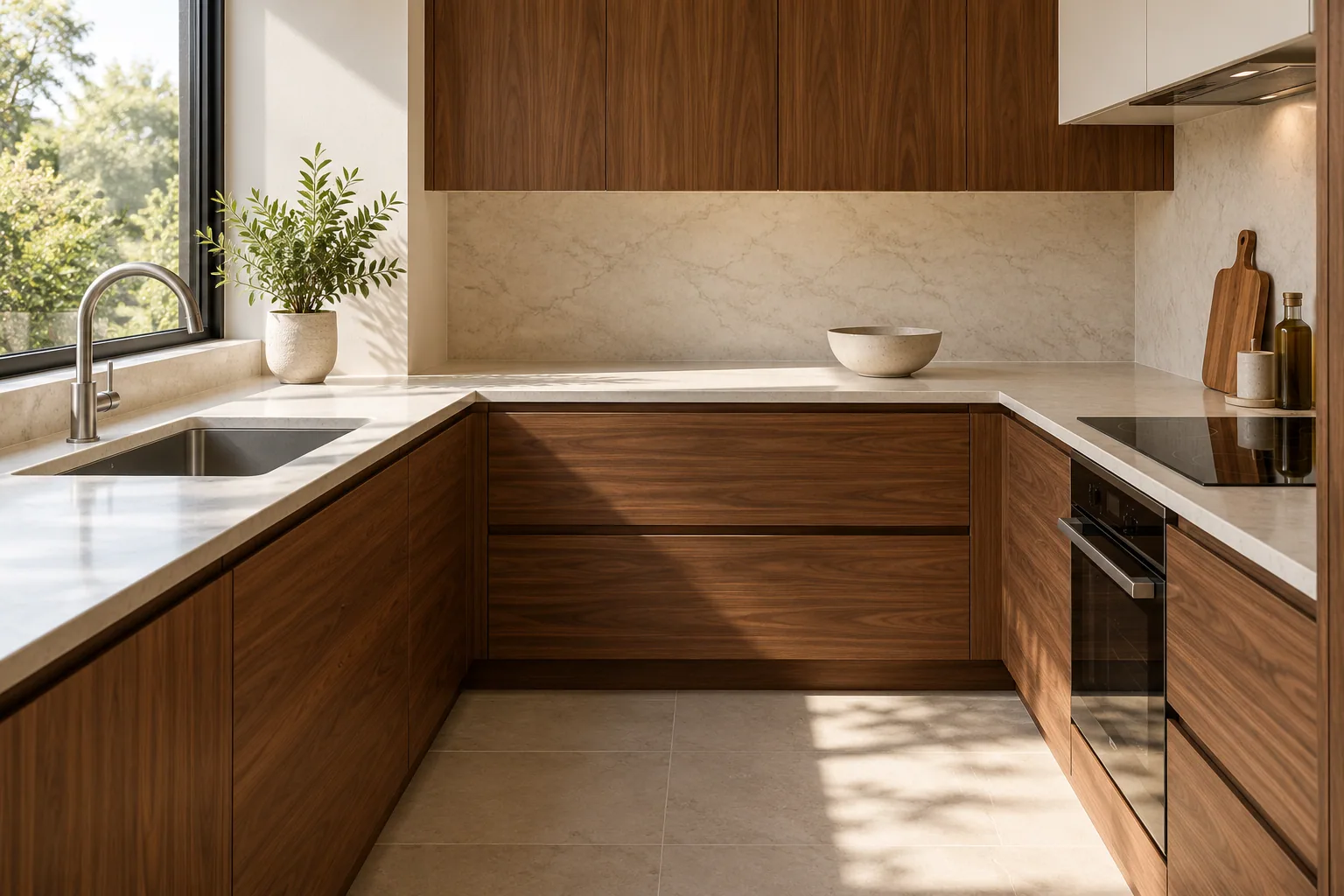
The stove belongs to the everyday life of the household
The stove is an important object in Feng Shui because cooking is connected with sustaining the household. Its association with abundance can sit alongside a kitchen that is reliable, cleanable and used regularly, rather than being expressed only through a decorative colour or object.
Follow the preparation of one meal: taking out ingredients, washing, cutting, cooking, serving and clearing. If one stage repeatedly crosses another person’s position, or a hot pan has no convenient resting place, the working areas deserve attention. An orderly sequence gives the cultural idea of nourishment a practical setting.
A separate kitchen, an apartment kitchenette and a room shared by several cooks require different amounts of surface and storage. A layout designed for a large kitchen can become awkward when copied into a compact home.
Fire and Water symbolism has more than one interpretation
A familiar interpretation associates the stove with Fire and the sink with Water, bringing attention to closeness or direct opposition. Some methods favor separation or a symbolic Wood transition. Other professional systems explicitly say that a modern sink near a stove is not automatically unfavorable. Identify the method rather than combining every recommendation into one prohibition.
In the existing room, look at splashes, whether washing and cooking obstruct each other, and the preparation surface actually available. These are observable conditions that help decide whether storage or the working sequence should change. A decorative element cannot replace appliance installation requirements.
If you want a Five Elements colour expression, a wood tone or green detail can sit in a suitable area away from heat and working space. Adding plants, fabric or wooden objects beside a burner simply to form a symbolic buffer may make the kitchen less useful.
Different kitchen shapes need different clear space
A single-wall kitchen forms a continuous working strip. If a usable surface lies between sink and stove, reserve it for preparation or temporary placement rather than filling it permanently with small appliances. Moving seldom-used equipment into appropriate storage may help more than adding a trolley in the route.
A galley kitchen must include the opening range of drawers, dishwasher and oven as well as people. Can the regularly used doors operate together? If not, changes in storage or the sequence of tasks may be more practical than adding an object between the two sides.
An open kitchen also receives movement from the living space. With dining chairs pulled out, can others pass outside the active cooking area? Does the island retain preparation space? A clear working zone helps family members know where to pause while talking.
- Single wall: preserve useful continuous preparation surface.
- Galley: include people and open appliance doors on the plan.
- Open plan: keep the main passing route outside active cooking.
Why references disagree about the stove’s facing
Traditional hearths had openings through which fuel was added, and facing conventions were connected with that form. A modern gas hob, induction surface and island cooker do not share an identical structure. A practitioner’s interpretation needs to explain how the method applies, rather than assuming one control or vent defines every stove direction.

Mark the appliance position, the direction faced by the cook, and the doors, windows and extraction equipment separately. The building’s facing, the kitchen’s sector and the stove’s orientation describe different things. A kitchen in the north is not the same statement as a person facing north while cooking.
In a rental or completed kitchen, an unexplained directional preference is a poor basis for moving services. Storage, lighting and working space offer other adjustments. Changes to appliances, plumbing or extraction need to follow the property and equipment requirements.
Air, light and storage are used every day
Cooking produces fumes and particles, and the US EPA recommends using suitable extraction during cooking. An unobstructed extraction route, equipment care and actual use matter directly to the room. Keep decorations away from vents and operating positions.
Preparation lighting should let the cook see food and tools. General and under-cabinet light can serve different roles. Check whether standing at the surface blocks the useful light; the working position tells more than a symmetrical arrangement of ceiling fixtures.
Give utensils, ingredients and cleaning items their own places, and maintain areas that collect grease. A gap above cupboards can remain manageable without being packed with rarely used objects. A clean usable stove, a workable preparation sequence and everyday gathering give the kitchen’s abundance theme a concrete expression.
Questions & answers
Is a sink beside the stove always unfavorable?
Approaches differ. Examine splashing, preparation surface and how the two areas are used rather than judging the whole kitchen by adjacency alone.
Can a plant act as a Fire-Water buffer?
Only consider a plant where light, space and appliance conditions suit it. Symbolic placement should leave heat sources and working areas unobstructed.
What can change when the stove is fixed in a rental?
Consider storage, lighting, equipment use and circulation while respecting the existing services and installation requirements.